Table of contents
For transportation modelers, PTV Visum Scenario Management helps keep long-term scenarios structured, comparable, and manageable. Assumptions, infrastructure projects, service concepts, and policy requirements – all change. That’s why planning teams need a reliable way to test variants without rebuilding large parts of the model.
This article reviews practical ways to structure scenarios in PTV Visum: how to separate measures into modifications, manage dependencies, keep evaluation consistent, and support collaboration in larger modeling projects. It is written for Visum users and mobility professionals who need scenario work to stay transparent over long planning cycles.
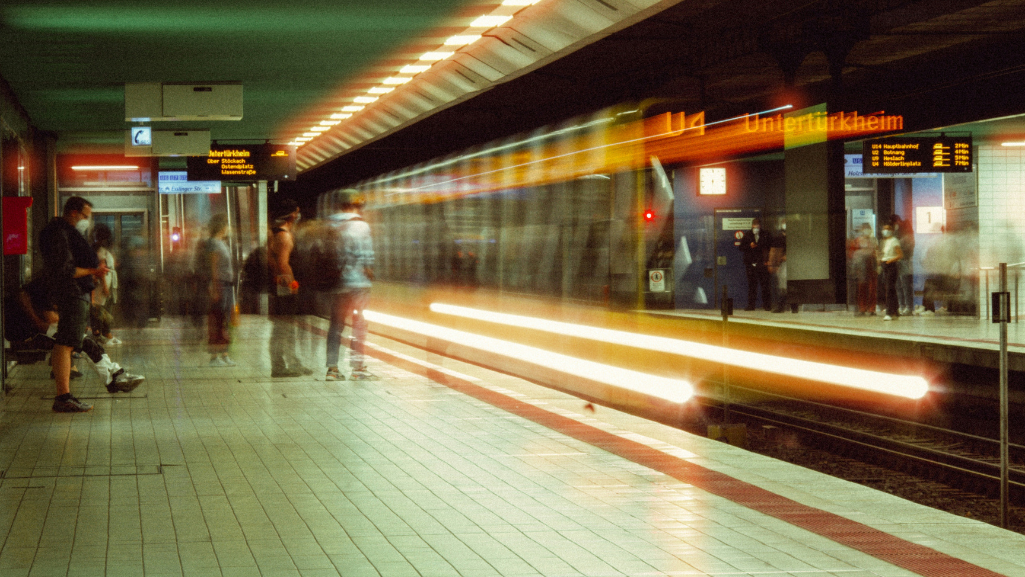
Stuttgarter Straßenbahnen AG (SSB) is responsible for the local public transportation in Stuttgart, Germany. Strategic planning requires the analysis of various transportation concepts well in advance, with traffic volumes and changing traffic flows playing a major role.
The goal is a well-thought-out concept for the future; the path to achieving this involves data-driven decisions, transparently presented scenarios, and analysis of how individual measures interact. These are challenges that many other PTV Visum modelers are likely familiar with.
PTV Visum Scenario Management provides the framework for this work. But its value depends on more than the software setup. To keep scenarios manageable, modelers need a clear structure from the beginning.
The examples in this article draw on public transport planning at SSB, but many of the structuring principles also apply to other transportation models.
PTV Visum Scenario Management
Before setting up a Scenario Management, the key question is not technical but conceptual: what exactly needs to be compared?
Some measures should be modeled separately because they may need to be analyzed individually. Others only make sense as part of a larger package. If this distinction is unclear at the start, the scenario structure can become difficult to maintain later.
For example, a larger public transport concept may consist of several sub-measures. Modeling these in separate modifications can make it possible to calculate the complete concept while still allowing individual elements and their interactions to be analyzed. This is useful when planners need to understand not only whether a concept works, but also how different parts of it contribute to the result.
The same applies to infrastructure and service concepts. If several service variants use the same infrastructure, it is usually better to model the infrastructure separately and let the service variants build on it. Otherwise, the same infrastructure changes may be duplicated across several modifications, making the model harder to manage and update.
Modifications
In PTV Visum Scenario Management, modifications are a central building block. They represent changes to the base model and allow modelers to combine different measures into scenarios.
This flexibility is valuable, but it should not lead to an uncontrolled number of loosely defined modifications. In principle, Scenario Management can handle many modifications. In practice, every additional modification adds complexity. Loading times may increase, and the overall project structure can become harder to comprehend.
Clear naming conventions and grouping rules are therefore essential. A modification name should make its purpose understandable, not only to the person who created it, but also to colleagues who may work with the model months later.
This is not just a matter of tidiness. In long-term modeling projects, unclear structures create real risks. If modelers cannot quickly identify which modification represents which measure, scenario comparison becomes less transparent and errors become harder to detect.
Dependencies
One of the most important lessons in scenario modeling is that model elements can depend on each other in ways that are not immediately apparent.
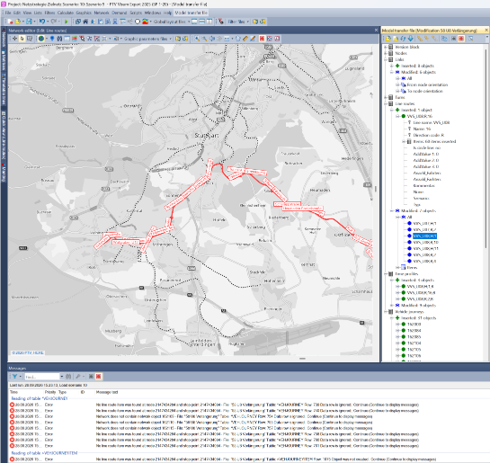
A change may look local at first glance. But if it affects an element that is referenced by another modification, problems can occur when different modifications are combined in scenarios. In public transport modeling, this can happen when infrastructure changes influence line routes or other connected elements.
For this reason, later changes to existing modifications should be made when strictly necessary and then only with care. A small change in the network can have consequences for dependent modifications, even if the visible modeling content appears almost unchanged.
PTV Visum offers features to check whether modifications are independent or compatible. These checks are very helpful, especially in complex projects. However, they do not replace careful scenario design. Modelers still need to understand which elements are likely to interact and where conflicts may occur.
Evaluation
Scenario Management is not only about building scenarios. It is also about comparing them.
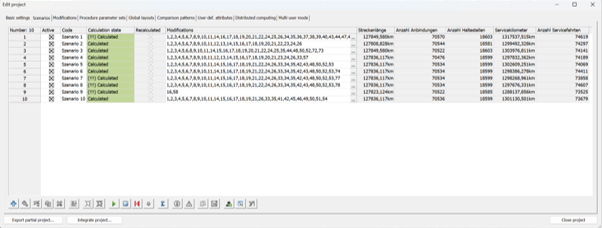
Procedure parameter sets, global layouts, and comparison patterns help create a consistent evaluation framework. On the one hand, this is essential because a fair comparison is only possible if the scenarios are calculated on the same basis.
On the other hand, a consistent setup simplifies the evaluation and helps ensure that differences between scenarios reflect the modeled measures, not accidental differences in calculation procedures or reporting. For a long-term project, this consistency is especially important.
Transport models support decisions on different levels and often involve many stakeholders. Clear and comparable results make it easier to explain why scenarios differ and what those differences mean for planning.
Collaboration
Large-scale Scenario Management projects are often developed by more than one person. PTV Visum Scenario Management supports multi-user workflows when tasks are divided into clear sub-steps.
This can be useful, for example, when different users work on different areas, measure groups, or modeling components. However, collaboration also increases the need for structure. Teams need shared rules for naming, grouping, editing, reviewing, and documenting modifications.
Individual modifications can be edited by only one user at a time. For multi-user operation, an SQL server is required. Depending on the setup, this server can also be installed on a single computer and made accessible within the network.
The technical setup is only one part of successful collaboration. The larger challenge is maintaining a model structure that the entire team can understand.
Scenario Conflicts
Even with careful preparation, not every combination of modifications will work immediately. Conflicts may occur when different modifications affect the same model area or depend on the same elements.
When this happens, modelers usually have several options. They can adjust the load order of modifications, revise one modification to avoid overlap, or create a separate combined modification that represents the desired final state. The latter option results in certain content being duplicated in the Scenario Management. It therefore enables a scenario to be loaded without errors.
There is no universal best solution; rather, the right choice depends on the specific problem. Conflicts are much easier to resolve when the scenario structure is transparent. If modifications are clearly defined, it is easier to understand why a conflict occurs and how it should be handled.
Structure First
PTV Visum Scenario Management provides modelers with a flexible framework to represent and compare future public transport scenarios. It supports individual measures, combinations of measures, different assumptions, and structured scenario evaluation within one modeling environment.
But flexibility does not remove the need for discipline. The more complex the planning task, the more important a clear initial structure becomes.
Before building scenarios, modelers should clarify which measures need to remain separate, which variants depend on each other, where overlaps may occur, and how the project should stay understandable over time.
For long-term transportation planning, this is essential. A model is not only a technical calculation tool. It is a decision-support system. The clearer the scenario structure, the easier it becomes to compare alternatives, explain results, and respond when planning conditions change.

Try PTV Visum demo
See how PTV Visum supports model-based planning, scenario analysis, and public transport decision-making
Try PTV Visum
Related Posts