Table of contents
Metropolitan regions across Europe are revisiting existing rail infrastructure to improve public transport connectivity. One increasingly attractive option is the introduction of passenger services on orbital railway corridors that were originally designed for freight operations.
In Poland, when the Wielkopolska regional government and the City of Poznań commissioned a study of a potential orbital rail service, the key question was not whether such a service could attract passengers. The more challenging question was how it should operate to deliver the greatest benefit to the broader transport network.
As transport planners, we often face situations where several seemingly reasonable service concepts are available. The difficulty is identifying which one will generate the strongest mode shift, improve public transport accessibility, and integrate most effectively with the existing network before making costly investment decisions.
That was the challenge we set out to address.
Beyond Build vs. No Build
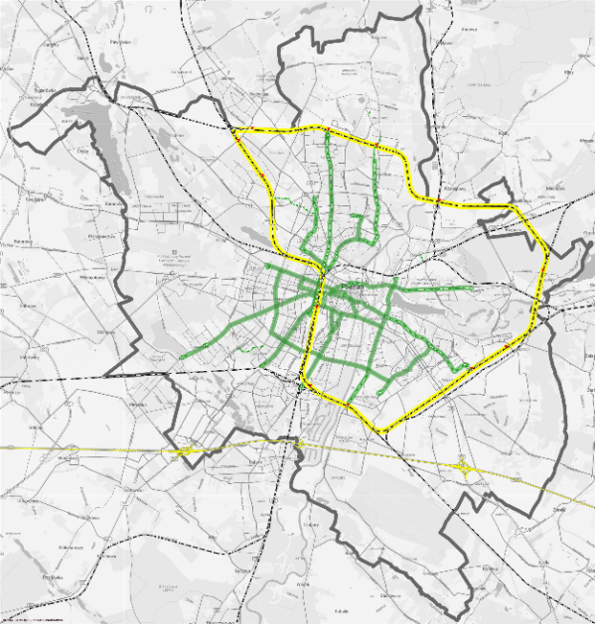
The proposed project involved introducing passenger services on the orbital railway corridor in Poznań. This corridor will provide new opportunities for traveling cross-city without having to travel through or transfer in the city center.
However, evaluating the infrastructure alone would not have been sufficient.
Different operational concepts can produce very different outcomes, even when they use the same railway corridor. Frequency, service patterns, terminal locations, feeder connections, and timetable integration all influence how passengers respond to a new service.
To understand these effects, we decided to test multiple future scenarios rather than a single implementation concept.
Building the Model
Before comparing service variants, we first updated the regional transport model.
This work included importing and correcting public transport stop data, updating the transport network, integrating timetable data from multiple operators through GTFS feeds, and verifying network consistency. The process combined data from local public transport operators, regional rail services, and national rail operators.
A particularly important step was model calibration.
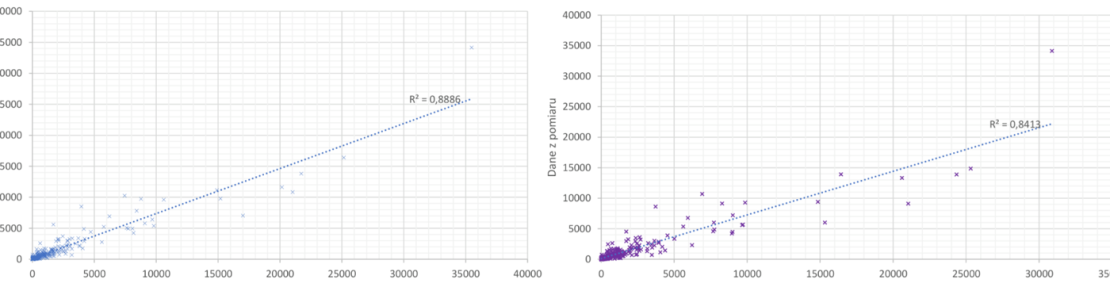
Passenger boarding and alighting data from approximately 2,500 stops were incorporated, drawing on information provided by ZTM Poznań, the Marshal’s Office of the Wielkopolska Region, and the Polish Office of Rail Transport. The calibration process achieved strong agreement between observed and modeled passenger volumes, providing confidence that the model could be used for strategic scenario testing.
This is where PTV Visum proved particularly valuable. Rather than evaluating rail services in isolation, the platform allowed us to work within a calibrated multimodal environment where changes to rail, bus, and wider public transport services could be assessed consistently.
Testing Five Scenarios
Using PTV Visum, we developed and evaluated five operational concepts for the orbital rail service. The scenarios varied in service frequency, operating patterns, integration measures, supporting bus services, and future network enhancements.
This approach enabled us to move beyond assumptions and compare the likely network-wide effects of each concept.
The objective was not simply to identify the scenario with the highest passenger demand. Instead, we wanted to understand broader impacts, including:
- Passenger distribution across the network.
- Public transport attractiveness.
- Effects on existing tram and bus services.
- Changes in mode share.
- Potential reductions in private vehicle trips.
For transport authorities, these questions are often more important than demand forecasts alone.
The Key Insight
One of the most valuable lessons from the study was that operational design mattered significantly.
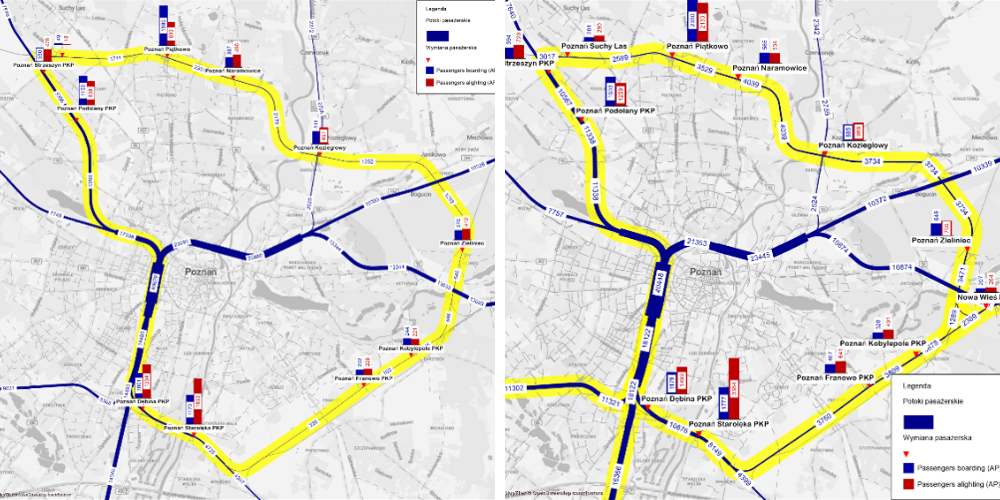
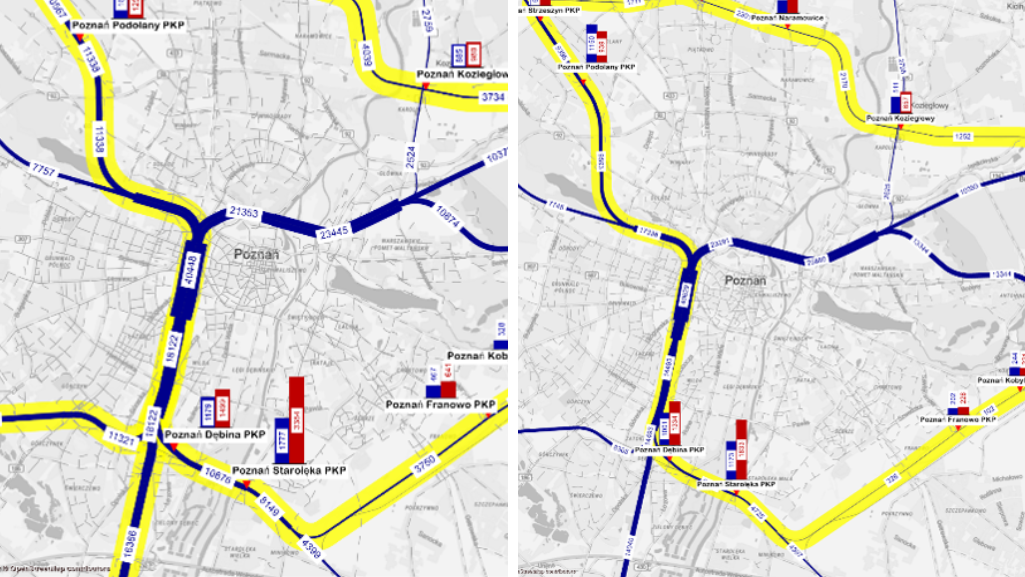
The results showed that different orbital rail concepts produced noticeably different outcomes across the transport system. Some variants generated only modest impacts, while others delivered stronger shifts toward public transport and more substantial reductions in private transport demand.
Particularly interesting was the influence of network integration measures.
The analysis demonstrated that feeder bus services, service coordination, and operational design substantially affected the attractiveness of the orbital rail concept. In some locations, additional feeder services improved accessibility and station performance, highlighting the importance of viewing rail investments as part of a wider mobility system rather than as standalone projects.
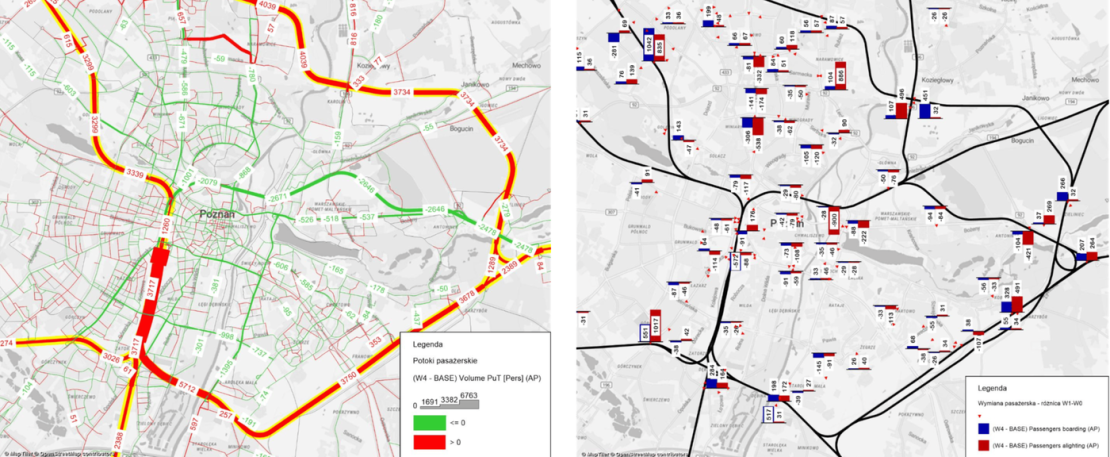
Another important finding was that reducing service intervals and optimizing service organization increased the attractiveness of the orbital rail line. The strongest-performing variant generated the largest shift from private transport while also reducing demand on selected tram corridors.
Why Scenarios Matter
If we had evaluated only one operating concept, many of these differences would have remained hidden.
This is where scenario-based planning creates value. Transport authorities can rarely test multiple futures in the real world. Modeling provides a practical way to understand the consequences of different decisions before implementation.
For the Poznań study, the greatest benefit was not simply estimating demand. It was reducing uncertainty.
PTV Visum enabled us to compare several integrated transport futures using a common analytical framework. As a result, decision-makers could evaluate not only how many passengers might use the orbital railway, but also how various service concepts would influence the broader metropolitan transport system.
Lessons for Metropolitan Rail Planning
Many cities are exploring orbital rail, suburban rail, and regional rail initiatives to improve sustainable mobility.
Our experience in Poznań suggests that the success of these projects depends not only on infrastructure, but also on how the service is designed and integrated with the wider public transport network. Frequency, feeder services, and network coordination can significantly influence outcomes.
For planners and transport authorities, this reinforces the value of testing alternatives before selecting a preferred concept. A calibrated multimodal model can help reveal which scenario delivers the strongest network-wide benefits and support more confident investment decisions.
In the case of Poznań, the most important lesson was: when evaluating orbital rail, the critical question is often not whether to introduce the service, but how to operate it most effectively.

Evaluate Rail Concepts with Confidence
Explore how PTV Visum helps planners compare rail concepts, assess impacts, and support investment decisions.
Evaluate Rail Concepts with Confidence
PTV Visum helps planners compare rail concepts, assess impacts, and support investment decisions
Related Posts