
Table of contents
Low Emission Zones are moving from policy discussion to delivery. Cities are asked to define boundaries, specify compliance rules, and explain expected outcomes, often with limited time and imperfect data. In that context, this question matters: how do we make LEZ evaluation testable before implementation?
Our approach is: treat an LEZ as a set of scenarios, not a single intervention. Instead of debating one proposed design, we compare variants with different ambition levels and measure how each one changes network performance and accessibility. That is how an LEZ becomes something you can evaluate, communicate, and refine.
In our research on LEZ impacts in large Polish cities, we use PTV Visum to translate policy rules into model inputs, run consistent scenario experiments, and extract indicators that are meaningful for both researchers and public agencies. The goal is not to “predict the future perfectly.” The goal is to build evidence that is structured enough to support real decisions.
Although this article focuses on LEZ evaluation, the scenario-based workflow comes from a broader research programme on extreme events and policy-induced mobility change.
Why scenarios
An LEZ is not one choice. It is a bundle of choices:
- Which emission standards are allowed, and when do they tighten?
- Which areas are covered, and where do boundary effects appear?
- How quickly does compliance grow as the fleet changes?
- How do effects differ for short versus longer trips?
If you evaluate only one configuration, your results are fragile. Scenario-based modelling forces you to compare like with like. It also makes uncertainty explicit, which is often more useful for decision-making than a single headline number.
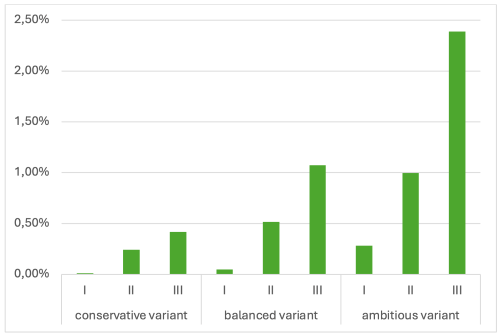
We typically frame variants as conservative, balanced, and ambitious. This creates a practical range that decision-makers can understand. It also helps research teams focus on what changes between scenarios, rather than re-litigating the entire modelling set-up each time.
The example shown below is from Wrocław – short-trip accessibility potential.
What to measure
LEZ evaluation can quickly become ideological. We prefer it to stay measurable. In practice, we use two complementary lenses.
Network lens
This is the language most transport departments already use:
- link flows and congestion indicators (for example volume-to-capacity ratios),
- speeds and travel times,
- redistribution of traffic around the LEZ boundary.
This lens answers questions like: where does traffic move, where does congestion worsen or improve, and which corridors become more sensitive under stricter rules?
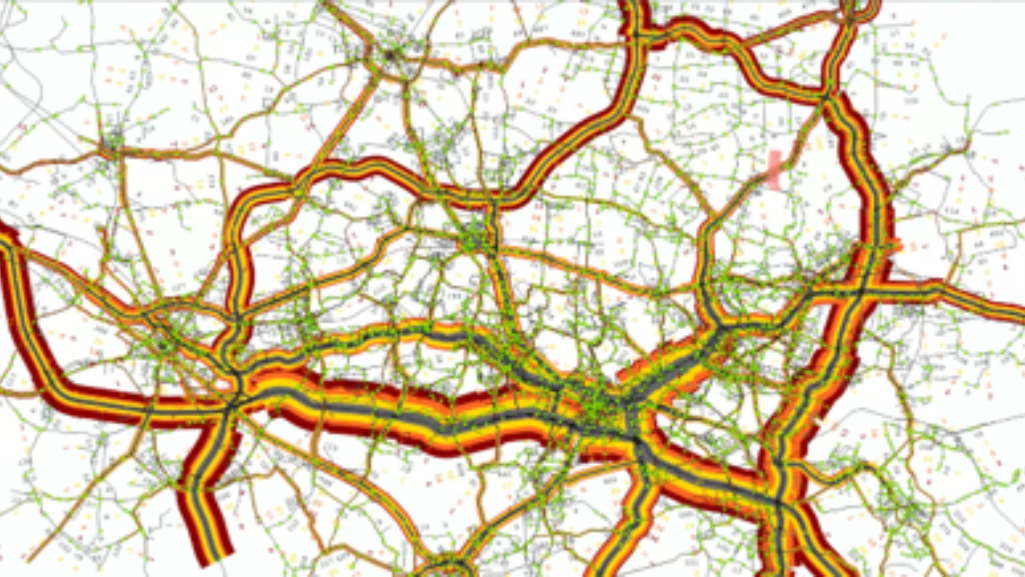
The figure below illustrates the type of link-level redistribution we inspect, shown here from a related scenario study.
Accessibility lens
Performance metrics alone can miss the “who and where” dimension. That is why we also compute zone-level accessibility measures from scenario travel times.
Accessibility helps you talk about outcomes that matter to agencies and universities alike:
- spatial distribution of impact,
- differences between neighborhoods,
- potential equity concerns that are not visible in network averages.
Used together, these lenses make it harder to hide behind a single indicator, and easier to explain trade-offs transparently.
These accessibility measures are scenario-comparative and model-based; they are not forecasts of realized travel, but indicators of relative sensitivity to LEZ rules.

From rules to model
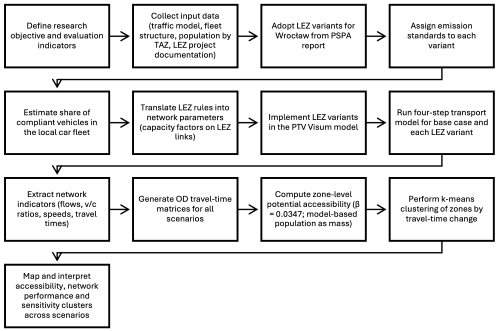
To make the work defensible, we suggest building an explicit chain from policy to outputs. In plain terms, the workflow looks like this:
- Set the objective and indicators: Decide what “success” means for the evaluation. Is it network efficiency, accessibility stability, reduced exposure for sensitive areas, or a balanced package?
- Collect inputs that match the policy: At minimum, you need a transport model, fleet structure assumptions, zonal population or activity data, and a clear description of the LEZ rules.
- Define LEZ variants: Conservative, balanced, ambitious is a useful starting point. What matters is that the variants are clearly distinguishable and politically interpretable.
- Translate rules into model parameters: This is the critical step, and it is where many evaluations become vague. You need a consistent way to represent compliance and any resulting changes in network conditions.
- Run base and scenario cases in PTV Visum: The value here is consistency. You want the scenarios to differ only in the LEZ assumptions, not in unrelated model settings.
- Extract outputs for analysis: Network indicators, scenario travel times, OD matrices, and zonal metrics allow both technical assessment and clear visual interpretation later.
We like this pipeline because it is auditable. When stakeholders disagree with results, you can point to the translation step and discuss assumptions directly, rather than arguing about “the model” in general.
Useful outputs
One of the most useful outputs is the comparison of accessibility change across variants. Even when the direction of change is unsurprising, the magnitude and spatial pattern often differ sharply between conservative and ambitious settings.
This is where scenario-based LEZ evaluation becomes practical:
- You can identify zones that are consistently sensitive across all variants.
- You can spot areas that only become problematic under the strictest design.
- You can separate “political preference” (how ambitious) from “technical risk” (where impacts concentrate).
For public agencies, this is a defensible way to talk about trade-offs. For researchers, it is a repeatable experimental design that supports publishing and peer review.

Why PTV Visum fits
For LEZ evaluation, we need three things to work reliably:
- Scenario comparability: Base case and variants must be consistent so that differences are attributable to the LEZ design.
- Transparent outputs: Link performance, travel times, and zonal results should be easy to export and analyze.
- A scalable workflow: Agencies rarely evaluate only one intervention. Once the scenario spine exists, it can support additional tests, sensitivity checks, and extensions.
In our work, PTV Visum enables that combination. It supports scenario runs that remain consistent, while still producing the indicators and matrices we need for accessibility and spatial interpretation. That does not replace careful assumptions. It makes the assumptions testable.
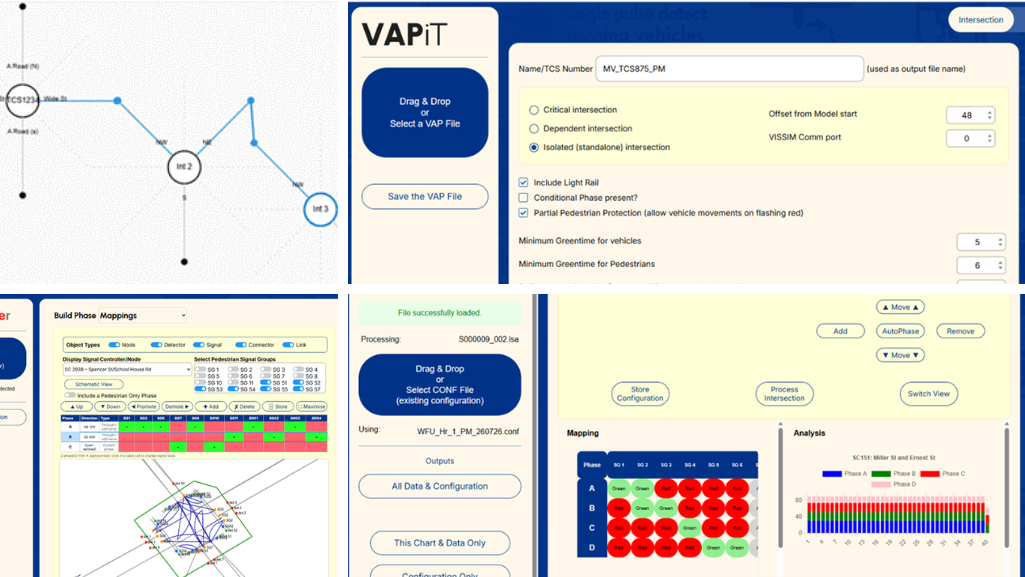
The example below is from related scenario work, used here to illustrate integrated inputs and comparable outputs.
Where microsimulation helps
Strategic scenario results often point to specific “hot spots,” for example:
- boundary crossings where rerouting concentrates demand,
- junctions that become unstable under small flow changes,
- corridors where bus operations and local friction drive capacity.
That is where microsimulation can add value. For example, PTV Vissim can be used to test operational effects at those locations, once the strategic model has identified where to zoom in.
In LEZ studies, microsimulation is typically a second-step tool, used selectively once strategic scenarios signal network stress.

What you can reuse
If you are building an LEZ evaluation, we recommend a few disciplined habits:
- Always evaluate multiple variants so conclusions do not depend on a single design.
- Document the policy-to-parameter translation so debates focus on assumptions, not on vague “model trust.”
- Report both network and accessibility outcomes to capture performance and spatial distribution.
- Use sensitivity interpretation (where outcomes are stable vs fragile) to support robust decision-making.
- Treat results as decision support rather than a promise and be explicit about what is assumed versus observed.
This is how scenario-based modelling turns an LEZ from an argument into an evaluation.
Conclusion
LEZ decisions are difficult because they combine climate and health goals with everyday mobility. In our experience, the best way to make those decisions credible is to make them testable.
Scenario-based LEZ evaluation in PTV Visum gives agencies and researchers a structured way to compare options before implementation, quantify trade-offs, and communicate impacts clearly. Once that strategic evidence is in place, you can decide where deeper operational analysis is needed, and where the policy is already robust.

Explore resilient infrastructure modelling
How scenario-based modelling supports defensible LEZ evaluation
Explore resilient infrastructure modelling
How scenario-based modelling supports defensible LEZ evaluation
Related Posts