Table of contents
PTV Vissim signal behavior sets the practical capacity of many urban road networks. If we do not represent signals credibly, the rest of the model can be excellent and still fail the one test that matters, “does it behave like the street?”
In this article, I introduce VAPiT, a web-based tool I built to help PTV Vissim users create adaptive, coordinated signal behavior in a faster, more transparent, and more repeatable way.
If you work with SCATS, or a comparable adaptive system, you will recognize the gap between “coded” signals and signal behavior that is defensible in review.
Disclosure: VAPiT is a commercial web-based product developed by Rd Traffic Insights, a company I co-founded.
Why this matters
On many projects, I have seen robust modeling work undermined by one weak point: Signal behavior that is hard to reproduce, hard to audit, and even harder to explain.
Fixed-time signals can get you part of the way. Bespoke vehicle-actuated logic can look impressive. But neither guarantees that adaptive behaviors have been represented consistently across a corridor or network, especially under multiple future scenarios.
When that certainty is missing, the consequences are not theoretical:
- Models can be rejected during operational review.
- Rework can expand timelines and budgets.
- Decision-makers lose confidence in scenario results.
What is VAPiT
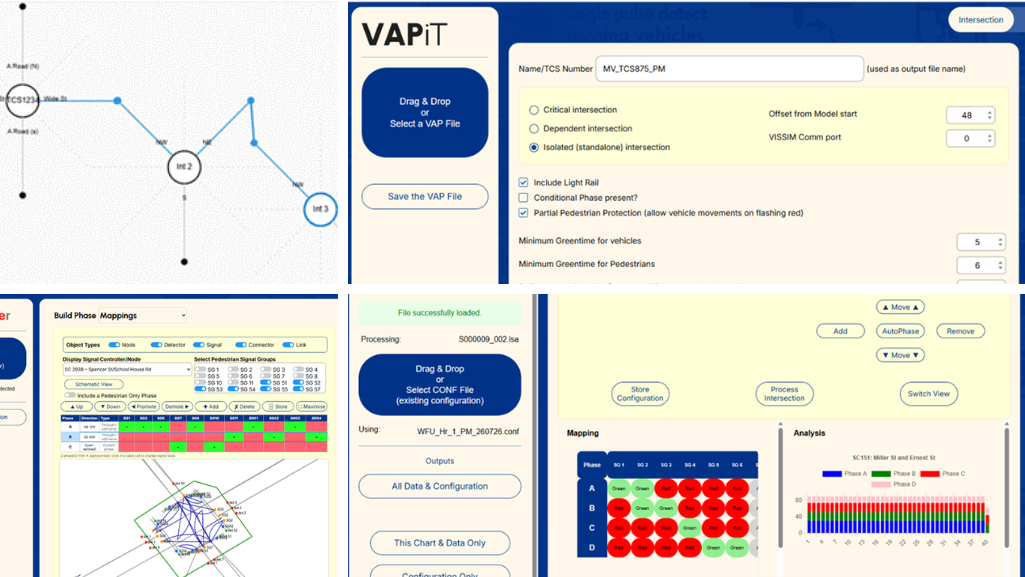
VAPiT stands for Vissim Analysis, Performance and Interrogation Tool. It is a web-based application to make PTV Vissim signal behavior adaptive, coordinated, fast, transparent, and repeatable.
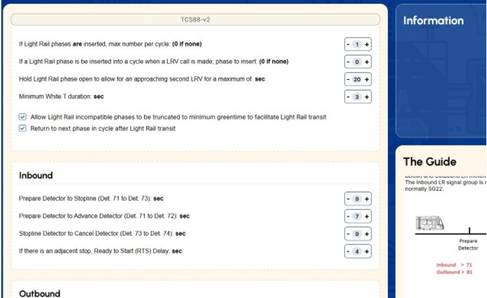
In practical terms, VAPiT generates a downloadable VAP file for direct use in PTV Vissim. What used to take weeks of manual controller logic coding can become a structured, guided process.
What VAPiT captures
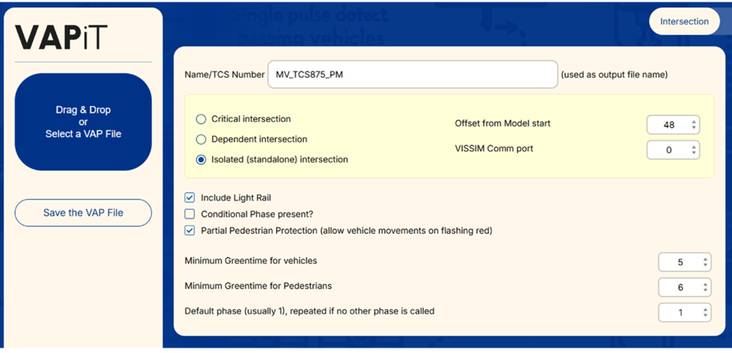
VAPiT is designed around operational behaviors that reviewers care about, not just “green time on paper.” For example:
- Pedestrian protection and clearance logic
- Light rail priority
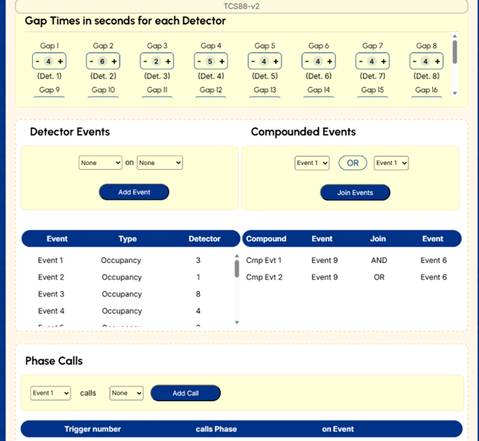
- Fully demand-driven phases with gap timers
- Stretch phases to maintain offsets
- Occupancy detection and realistic responses to detector inputs
The approach is useful even if you are not modeling SCATS specifically, because it improves documentation and repeatability of signal logic in general.
What you need to prepare
To use VAPiT in PTV Vissim, I start with a network that already includes one or more VAP-controlled signal controllers. The main inputs are the phase plan, detector layout, pedestrian rules, cycle and phase timings, any program change points, and, where relevant, light rail priority settings.
Most of that information already exists in controller drawings, specifications, and field notes. VAPiT then generates the VAP file needed to run that logic in PTV Vissim. If the inputs are complete, the remaining step in PTV Vissim is mainly linking the controller to the exported file.
PTV Vissim signal behavior: Why repeatability matters
This is the core problem I wanted to solve. If the signal logic is not repeatable and auditable, your future-year results will always be questioned, even if the rest of the model is strong.
Repeatability beats cleverness, every time. A structured approach that others can understand and reproduce will outperform bespoke logic over the full project lifecycle, especially when a model changes hands.
This is also where I find PTV Vissim particularly valuable. It gives me the flexibility to test operational strategies in detail, including multimodal interactions, and it gives stakeholders a familiar environment for review. The bottleneck has often been getting credible, defensible signal behavior into that environment at the speed projects demand.
How reviewers can verify the behavior
For reviewers, credibility comes down to a few practical checks. Can they see that cycle lengths are being maintained? Can they see how offsets are recovered after insertions or priority events? And can they confirm that minimum greens and clearance rules are not being violated?
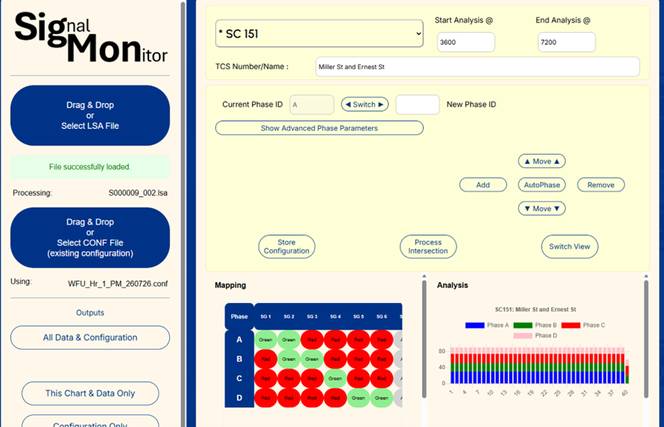
That is where Signal Monitor is useful. It provides cycle-by-cycle timing outputs and highlights exceptions, making it much easier to review, explain, and defend the controller logic generated by VAPiT.
Why I built VAPiT
I built VAPiT because signal behavior is often the hardest part of a PTV Vissim model to defend. On corridor and network projects, controller coding took too long, inconsistencies created different behaviors between junctions, and assumptions were difficult to audit or hand over.
VAPiT turns that process into a structured workflow that can be reviewed, explained, and updated quickly.
Real project testing
For me, “tested” means tested under real scrutiny.
Every tool we build is used in live project environments, on real networks, against real approval criteria. If it does not stand up in our own work, it gets modified until it does.
Early versions of VAPiT were deployed on major light rail projects in Australia, including Canberra Light Rail Stage 1 and Parramatta Light Rail Stage 1. In those projects, realistic adaptive signal behavior was critical to assessing journey times and corridor performance.
The workflow also cut weeks from signal controller setup on larger projects, while making the resulting logic easier for reviewers and operations staff to understand.
What PTV Vissim signal behavior workflows help you deliver
Even if you never use VAPiT, there are three practical principles worth taking into PTV Vissim projects.
- Treat signal behavior as a credibility item. If signals are not defensible, scenario conclusions remain fragile.
- Design for handover. If someone else cannot reproduce your logic, you will pay that cost later.
- Make auditability deliverable. If you can explain what the controller did, cycle by cycle, stakeholder conversations become faster and less adversarial.
If you do decide to use VAPiT, the immediate benefit is time. The deeper benefit is confidence, because the process is structured and the outputs can be reviewed and communicated clearly.
A wider workflow
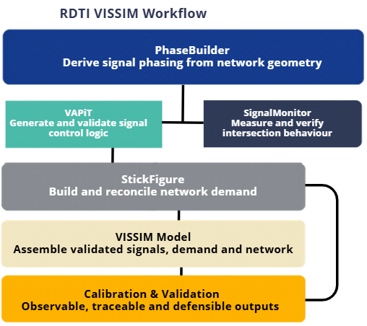
VAPiT is one part of a broader workflow. StickFigure helps clean and reconcile input data for calibration. Phase Mapper translates field phasing into a form that can be used consistently in PTV Vissim. VAPiT generates the adaptive controller logic, and Signal Monitor helps verify how that logic performs over time.
This workflow is most useful where controller behavior needs to be reviewed, reproduced, or transferred across scenarios and teams. On simpler fixed-time studies, the extra structure may not always be necessary.
Signal Monitor
Signal Monitor provides ongoing QA of signal logic. It helps demonstrate how signals operate on a cycle-by-cycle or hourly basis, including green splits, offsets, pedestrian clearance checks, and cycle time behavior, with outputs that can be used in reporting and audit trails.
Phase Mapper
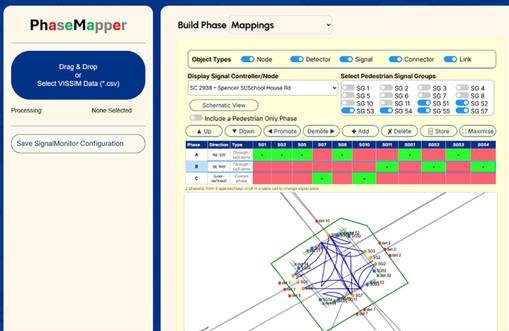
Phase Mapper streamlines the translation of real-world phase data into PTV Vissim’s signal group controller framework. It helps establish corridor and network-wide adaptive control consistent with SCATS-style outputs, while removing an error-prone step from the modeler’s workflow.
StickFigure
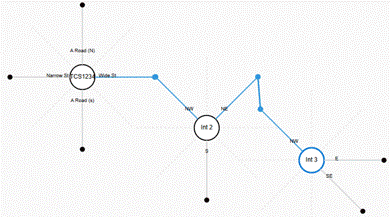
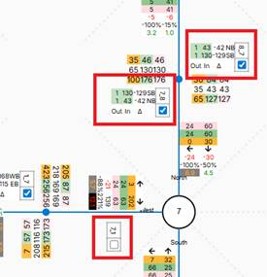
StickFigure focuses on the foundation, clean input data and faster calibration setup. It collates and flags multiple count sources, provides schematic network representation with turn-by-turn comparisons, and applies Basket Weave OD adjustment to move matrices toward calibration criteria without manual iteration loops.
Access and next steps
VAPiT is a commercial, web-based application from Rd Traffic Insights. A free 7-day trial is available, and no downloads are required, you can open a browser and get started.
I built these tools to solve project constraints, tight timelines, operational reviews, and the need to explain signal behavior clearly. If you are aiming for more realistic and defensible PTV Vissim signal behavior, I hope this article helps you.

Put traffic simulation in context
Make microscopic traffic simulation that matters –
for signalized junctions
and beyond
Put traffic simulation in context
Make microscopic traffic simulation that matters – for signalized junctions and beyond
Related Posts