Table of contents
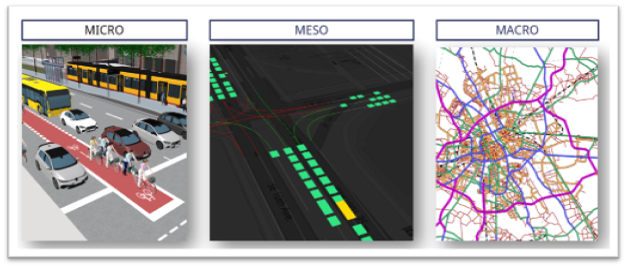
Mesoscopic modeling in PTV Visum is useful when a macro model is not detailed enough, but a microscopic model would be more detailed than the project needs.
This is a common situation in practice. A network may work well in a strategic model until congestion starts to build over time. At that point, queues, spillback, signal timing, and lane use can change the result in ways that average volumes and travel times do not capture well.
This is where simulation-based assignment, or SBA, becomes valuable in PTV Visum. It adds dynamic traffic behavior to the analysis without moving straight to the full detail of PTV Vissim. It gives planners and modelers a practical step between macro and micro modeling.
For many existing PTV Visum users, that is the key benefit. Mesoscopic modeling helps you answer operationally sensitive questions while staying within a planning-oriented workflow.
When macro is not enough
A simple question can help you decide whether mesoscopic modeling is worth considering:
Does the result depend on how congestion forms and spreads, not only on average volumes and travel times?
If the answer is yes, SBA should be on the table.
Macro assignments are often sufficient for strategic questions. They work well when you need to compare demand patterns, corridor performance, or broad policy options. They are less reliable when traffic dynamics affect the outcome.
Typical warning signs include:
- queues that spill back into upstream intersections
- signal interactions that affect capacity or route choice
- temporary disruptions that change conditions over time
- lane allocation measures that influence both operations and demand
- public transport measures that also affect general traffic
In these cases, average link-based results can hide effects that matter for the decision.
What mesoscopic modeling can reveal
Mesoscopic modeling does not reproduce every vehicle interaction in full detail. Instead, it shows whether dynamic traffic effects change the planning outcome in a meaningful way.
In practice, three use cases are especially relevant.
Queues and spillback
Queues are one of the clearest reasons to use mesoscopic modeling.
If traffic backs up and blocks upstream movements, a macro model may underestimate delay or miss the true bottleneck. A corridor can look acceptable in static assignment. But once spillback starts, the critical point may shift to another junction or turning movement.
Mesoscopic modeling helps you assess:
- where queues form
- how far they extend
- whether they block other movements
- how that changes travel times and route choice
This is especially useful in congested urban networks, where local effects can quickly influence the wider system.
Incidents and disruptions
Mesoscopic modeling is also valuable when the question involves Mesoscopic modeling is also valuable when the question involves short-term disruptions.
Incidents, temporary closures, and roadworks are dynamic by nature. Their effects depend on timing, duration, and network response. A static average is often not enough.
With SBA in PTV Visum, you can examine questions such as:
- how quickly congestion builds
- where it spreads
- how long recovery takes
- whether traffic shifts to alternative routes at the right time
This matters when the decision depends on what happens during the disruption, not just on an average daily result.
Bus lanes and public transport
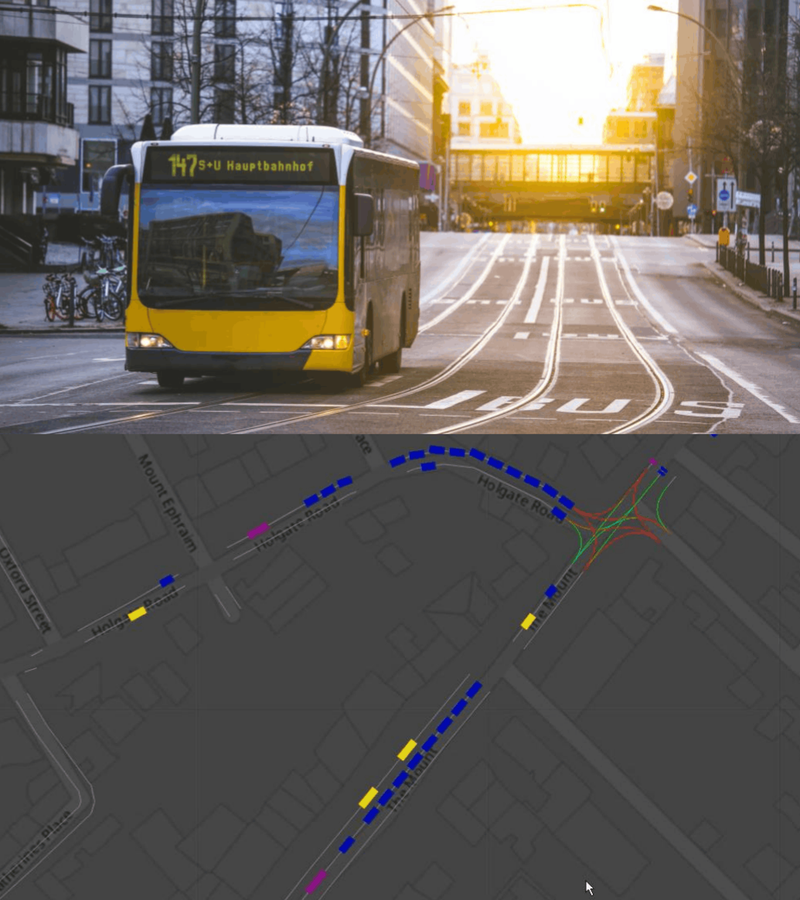
Bus lanes are another strong use case for mesoscopic modeling. SBA can also show how public transport and road traffic interact under realistic traffic conditions.
Public transport vehicles can be simulated explicitly in the mesoscopic model. This allows planners to assess the effects of congestion, junction control, lane allocation, and stop locations on service performance.
A dedicated bus lane is rarely only a public transport measure. It also changes road space for general traffic, affects delays, and can reduce timetable reliability.
Here, SBA can support analysis of:
- the impact of a bus lane, or another form of public transport priority, on overall traffic
- interactions between public transport vehicles and car traffic
- timetable realism under congested conditions
- punctuality during traffic disturbances
Mesoscopic modeling helps when public transport and general traffic need to be assessed together.
What changes when you move to SBA
For existing PTV Visum users, moving to SBA does not mean starting from zero. But it does mean that some model elements need more attention.
In practice, SBA usually requires a closer look at:
- intersection geometry, including the number of lanes, lane turns, and major flows
- junction control type, signal timings, and offsets
- transport system parameters that define simplified driver behavior
- demand and supply changes over time
This point matters for adoption. The goal is not to add detail everywhere. The goal is to add detail where the planning question requires it.
That is why mesoscopic modeling often works best as a targeted upgrade to an existing model. It is applied to those parts of the model where macro results are too coarse, but a microscopic model would be more detailed than the task requires.
Which outputs SBA adds in PTV Visum
SBA in PTV Visum produces standard assignment results as well as simulation-based outputs. In addition to volumes, travel times (tCur), and impedances, it provides mesoscopic indicators that show how traffic behaves over time and where congestion occurs.
The most important output variables are:
- SBA density, the average number of vehicles per km and lane during an analysis interval
- SBA utilization, a scaled version of density
- SBA queue length, the maximum queue observed during the analysis interval
For more detailed analysis, SBA also records link and turn delays. This is useful for assessing junction performance. The model also provides diagnostic values such as SBA capacity, SBA length, and conflict-related junction attributes. These help identify bottlenecks, missing lane turns, unrealistic conflicts, and gridlock problems.
If public transport is simulated, SBA also outputs the number of simulated vehicles, vehicle-kilometers, vehicle-hours, and measured PT times such as arrival, departure, post-run time, and stop time.
Overall, SBA results support both operational analysis and the calibration of network coding and junction behavior.
Three ways to apply mesoscopic modeling
In PTV Visum, mesoscopic modeling does not have to be an all-or-nothing decision.
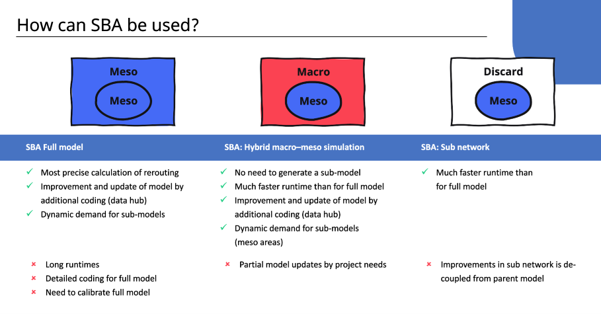
There are three practical ways to apply SBA, depending on the project scope, the required level of detail, and the available computation time. Each approach offers a different balance of accuracy, flexibility, and performance.
Apply SBA to the full network
The most comprehensive approach is to apply SBA to the entire network. In this setup, the whole network is represented at the mesoscopic level. This allows the simulation to capture traffic dynamics and route choice consistently across the study area.
This option is often suitable when:
- the highest level of accuracy is required
- network-wide traffic interactions must be represented consistently
- congestion is widespread
- time-dependent traffic behavior is central to the project
The main drawback is the effort required to build, maintain, and calibrate the model.
Large mesoscopic simulations can lead to long run times, especially in metropolitan areas. Updates and calibration also usually have to be done across the full network. This option is best suited to projects where maximum accuracy matters more than computational cost.
Combine macro and meso in one model
A hybrid macro-meso approach combines a detailed mesoscopic area with a larger macro model. Instead of converting the entire network into a mesoscopic representation, only selected areas are simulated in detail, while the surrounding network remains at the macro level.
This method is often the most practical compromise between accuracy and efficiency. This is often the right choice when:
- the wider model still needs macro coverage
- only a few corridors or zones show complex queue behavior
- you want more realism without rebuilding the full model
For many cities and regions, this is a practical first step because it limits effort while adding detail where it matters most.
The video below provides a step-by-step guide to the hybrid SBA implementation workflow:
Start with an SBA sub-model
The third option is to apply SBA to a standalone subnetwork taken from a larger parent model. In this case, only the area of interest is simulated, while the rest of the regional network is excluded from the analysis.
An SBA sub-model is often the best option when you want to test one hotspot first.
Typical examples include:
- one corridor
- a group of intersections
- an urban district
- a bus priority scheme
- a disruption-prone part of the network
Because the model is much smaller, simulation runtimes are shorter than in a full mesoscopic model or a hybrid setup. This makes the approach efficient for rapid assessments and project-specific analyses.
This approach is also useful when you want to test the value of mesoscopic modeling on a focused case before extending it further.
When SBA is not the right tool
SBA is not always the right answer.
If the project is mainly strategic, if congestion dynamics do not change the recommendation, or if broad policy comparison is enough, macro modeling may still be the better option.
At the other end of the spectrum, some questions require much finer operational detail. If you need highly detailed vehicle interactions, lane-changing behavior, or junction-level design assessment, PTV Vissim may be the better fit. The key point is simple. Mesoscopic modeling does not replace macro or micro modeling. It fits a specific middle ground.
A simple way to decide
If you are unsure whether mesoscopic modeling is worth the effort, ask these four questions:
- Do queues, spillbacks, or signal interactions influence the result?
- Is the decision sensitive to temporary conditions, not only steady-state averages?
- Would a full microscopic model be more detailed than the project needs?
- Would a more dynamic result change the planning recommendation?
If the answer is yes to most of these questions, mesoscopic modeling with simulation-based assignment is usually worth considering.
In PTV Visum, SBA offers a practical way to add dynamic traffic behavior where it matters. For many projects, this makes it an efficient step between strategic planning and microscopic simulation.
To learn more, see the SBA Practice Guide included with PTV Visum 2026, or watch the SBA video series on YouTube.

Explore Transportation Modeling
How modeling supports planning – and how to choose between macro, mesoscopic, and micro approaches
Explore Transportation Modeling
Learn how transportation modeling supports planning
and discover how to choose between macro, mesoscopic, and micro approaches
Related Posts