Table of contents
Fixed-time signal control combined with traffic light synchronization can help cities redesign complex street spaces with greater confidence, but only if it is tested in the wider context of pedestrian demand, access needs, and network operations.
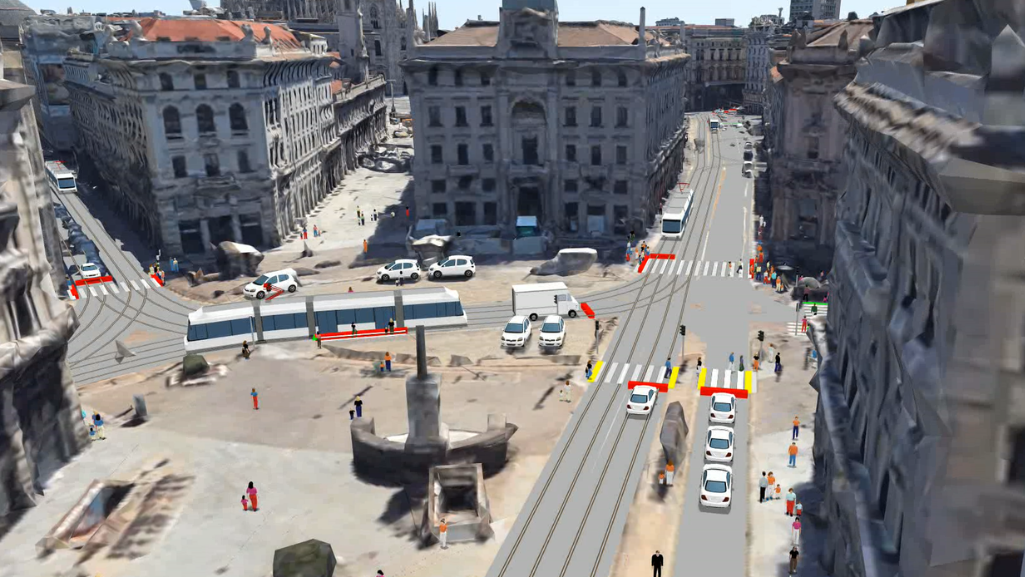
Piazza Cordusio was one of Milan’s most complex mobility nodes. Cars, trams, bikes, and pedestrians shared the same space, creating conflicts and inefficient movement patterns. We used PTV Vissim to understand how these interactions affected mobility and public-space quality.
The square functioned more as an intersection than as a public space. Using PTV Vissim, we tested how pedestrianization, revised signal timing, and constrained vehicle access would affect tram operations, traffic circulation, and public-space quality before implementation.
A key objective was to synchronize traffic lights and tram movements so that trams could cross the square without stopping in its center. By coordinating signal timings and removing stop lines within the square, we evaluated how pedestrian continuity, tram operations, and overall network performance could be improved together.
This article explains what we modelled, which outputs mattered most, and what lessons other planners can apply to similar tram-heavy urban streets.
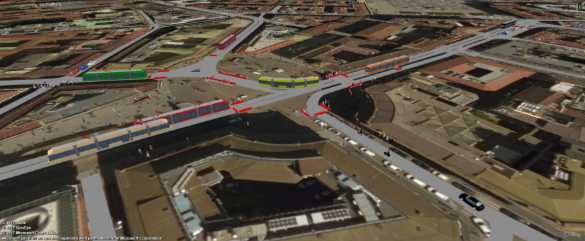
The challenge
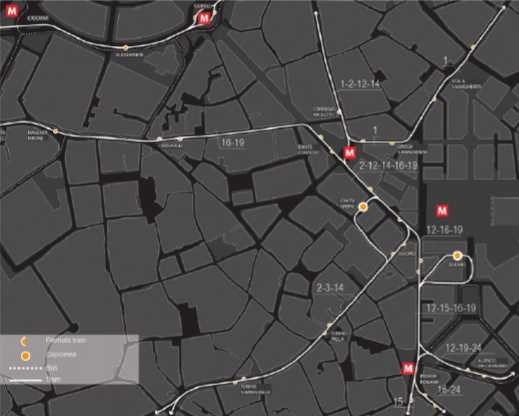
Piazza Cordusio sits at the heart of central Milan and functions as much more than a square. It is a multimodal hub that connects major pedestrian routes, tram corridors, and the M1 metro, while also accommodating tightly regulated vehicle access within a limited traffic zone.
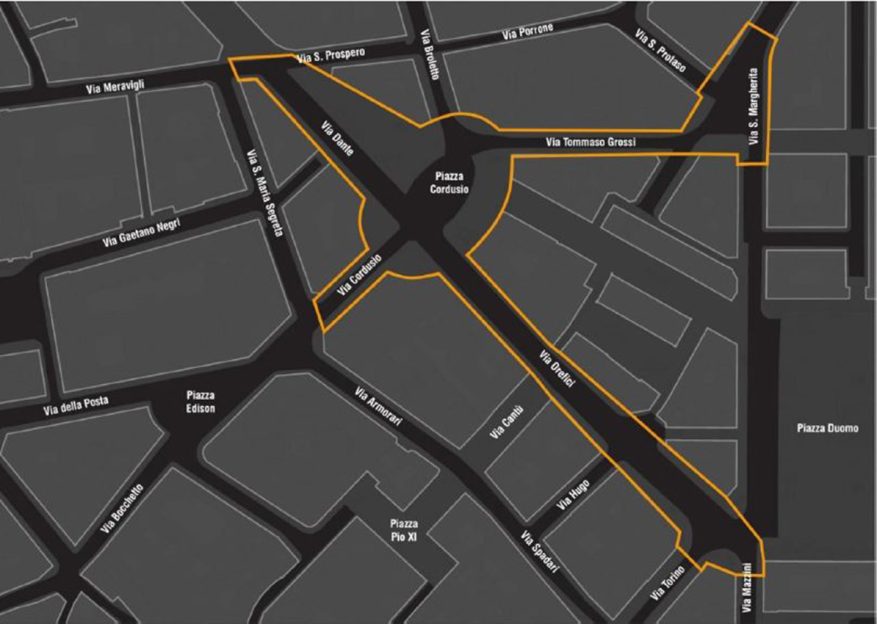
The study area included Piazza Cordusio, Via Dante, Via Orefici, Via Tommaso Grossi, and Largo Santa Margherita. This meant that movement, access, and public-space quality had to be treated as one system rather than as separate design questions.
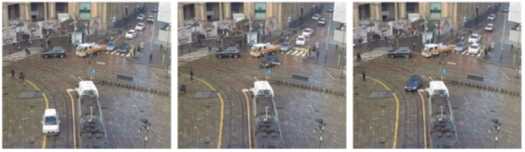
The existing conditions showed why that mattered. The area carried intense tram activity, high pedestrian volumes at key crossings, and vehicle movements that still created delay and conflict despite access restrictions.
Informal parking, suboptimal crossing conditions, and signal operations that interrupted tram movements or reduced pedestrian comfort all pointed to the same conclusion: geometry alone would not solve the problem. A key challenge was improving traffic light synchronization so that trams could move through the square more smoothly without disrupting pedestrian flow.
To understand these interactions, we needed to test how the entire multimodal system behaved under peak demand rather than evaluate individual design elements in isolation.
Why traffic light synchronization mattered
In a project like this, street redesign and tram operations could not be tested separately. Closing a street, reallocating pedestrian space, or moving a stop line may look simple on a plan; the real issue is what happens to tram delay, queues, crossings, and access once the network operates under peak demand.
That is why tram signal priority and traffic light synchronization became central to the study. The goal was to coordinate traffic signals and tram movements so that trams could cross the square more smoothly without stopping in its center and obstructing pedestrian flow.
We used PTV Vissim to model the area as a microscopic, multimodal system in which trams, taxis, general traffic, and pedestrians interacted under realistic operating conditions.
For current Vissim users, priority should not be treated as a controller detail alone. In tram-heavy urban centers, tram performance depends on how crossings, access rules, and surrounding junctions work together, making multimodal traffic simulation essential.
In Cordusio, the modelling question was simple: could the scheme improve pedestrian continuity and simplify circulation without undermining tram operations?
Building the PTV Vissim model
The model was built on detailed field data, including vehicle counts at eight intersections, pedestrian counts in Piazza Cordusio, and origin-destination matrices for cars, taxis, motorcycles, and light commercial vehicles.
We analyzed both morning and afternoon peak periods. Dynamic assignment was used so that routing could respond to actual network conditions rather than remain fixed.
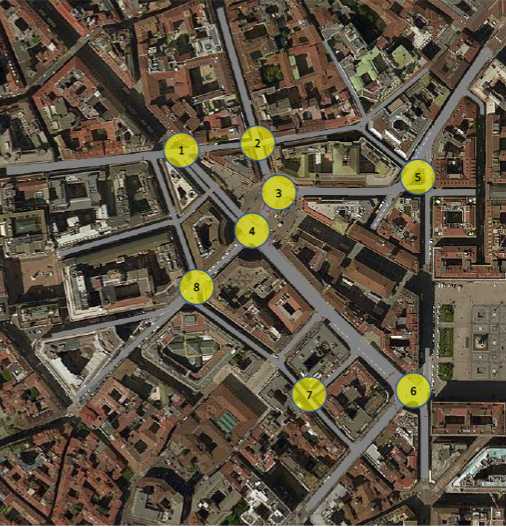
Model quality depends on whether the inputs reflect how the area really operates. In Cordusio, that meant capturing vehicle demand, pedestrian flows, and multimodal conflicts around the tram network. This was essential for testing traffic light synchronization under realistic conditions.
Because PTV Vissim is stochastic, we did not rely on a single run. We simulated the model with 16 random seeds to produce more robust results and reduce the risk of drawing conclusions from isolated variation.
Validation was equally important. The study reports an R² of 0.98 and GEH below 5 for 98 percent of flows, giving confidence that the base model was accurate enough for scenario testing.
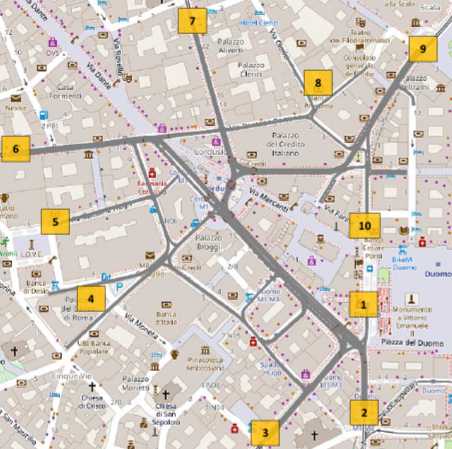
Testing traffic light synchronization, pedestrianization, and access
The project concept combined several linked changes:
- Via Dante was closed to general traffic,
- More space in Piazza Cordusio was reallocated to pedestrians,
- Through-movements were simplified,
- Taxi and motorcycle functions were reorganized,
- The tram alignment in Via Orefici was shifted to improve pedestrian space around a busy stop area.
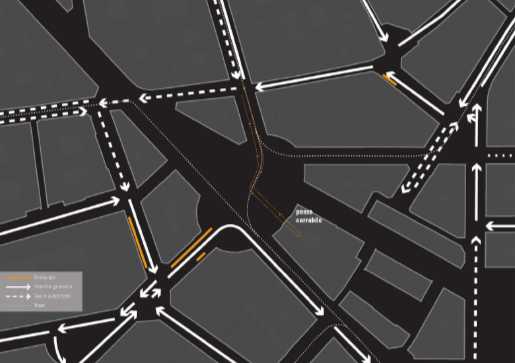
A key element of the proposal was traffic light synchronization, designed to better coordinate tram movements through the square and reduce unnecessary stops that could obstruct pedestrian flow.
The main scenario was tested first with fixed-cycle signal control, even though more advanced actuated technology was considered as a next step.
That was a sound choice because it allowed the team to assess whether the layout and circulation strategy were operationally viable before making the results dependent on additional control technology.
A practical lesson is to isolate the effects of geometry, circulation, and signal strategy before introducing more advanced control logic. In Cordusio, the model tested the scheme as an integrated multimodal system in which pedestrian demand, tram operations, and constrained access all influenced the outcome.
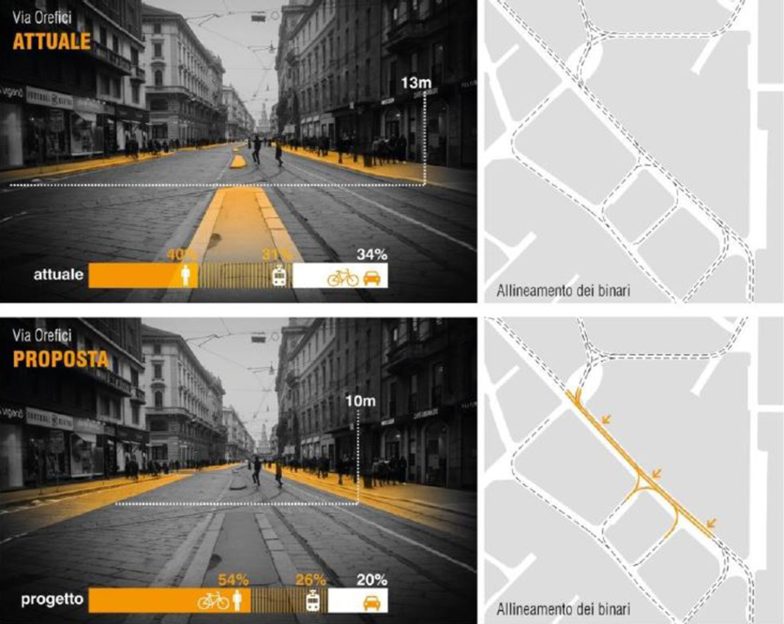
What the model revealed
The value of the exercise was that it did not simply confirm the design intent. It quantified the likely impact of the proposed street layout and signal strategy.
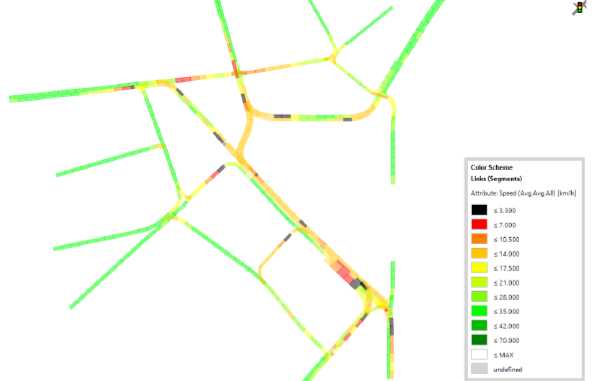
According to the study summary, the project scenario improved average network speed, particularly during the PM peak, while reducing delays and queues at key locations such as Piazza Cordusio and Via Orefici.
Signal operations were also simplified, moving from a 100-second cycle to an 83-second cycle in the tested scenario. This supported better traffic light synchronization and allocated more green time to pedestrian movements and crossings.
The most important takeaway is the choice of KPIs. Network speed, node delay, queue length, tram performance, and pedestrian conditions provided the basis for comparing alternatives.
The key result was that the redesign improved circulation and pedestrian continuity without materially undermining tram operations. The model showed that public-space reallocation and operational reliability could be improved together rather than treated as competing objectives.
Lessons for planners
For me, the main lesson is that simulation is most valuable when it answers a clear operational question rather than simply documenting existing conditions.
In Cordusio, we used PTV Vissim to test whether pedestrianization, revised access rules, and traffic light synchronization could improve pedestrian continuity without degrading tram operations.
For Vissim users, the practical takeaways are:
- Start with the decision you need to make. Define the operational question before building the model.
- Assess tram operations in context. Performance depends not only on signal settings, but also on crossings, access rules, short links, and queue spillback.
- Use realistic demand and routing. Reliable inputs are essential for meaningful scenario comparisons.
- Validate before comparing alternatives. A well-calibrated model provides confidence in the results.
- Test changes in stages. Evaluate geometry, circulation, and signal strategies before introducing more advanced control technologies.
This approach helped us evaluate pedestrian and tram needs together, rather than treating them as competing objectives.
Get a Vissim free demo

Simulate people-focused streets
How to test PT operations, pedestrian space,
and street redesign strategies