Table of contents
How much confidence should planners place in pedestrian flow simulation results when evaluating station safety, capacity upgrades, or future infrastructure investments? The answer depends on one critical factor: how accurately the model reflects local pedestrian behavior.
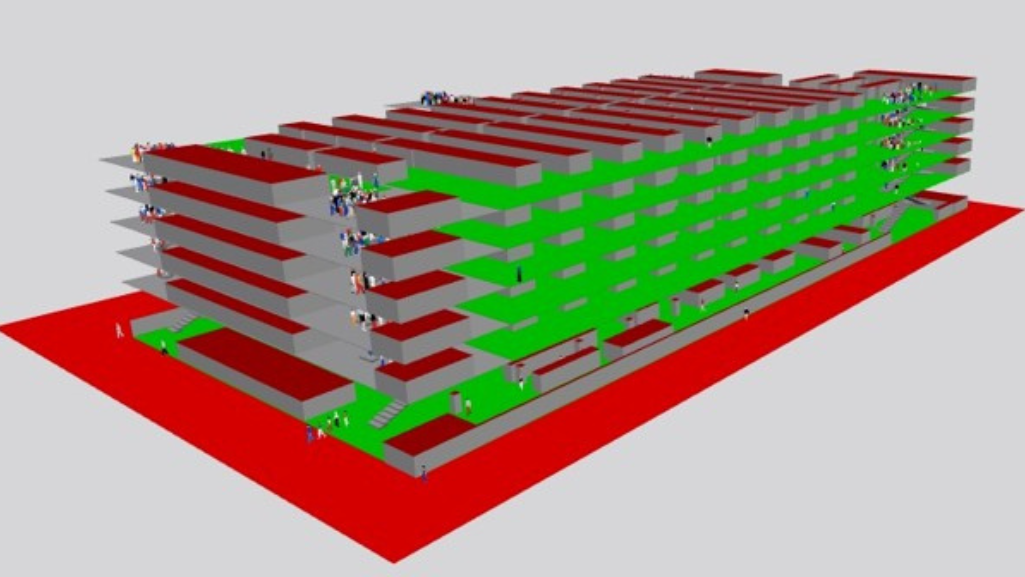
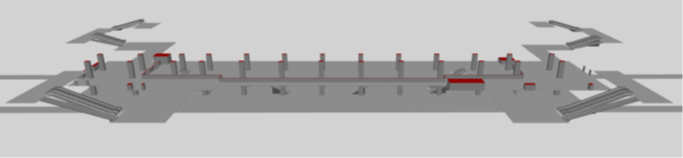
In this project, I used PTV Vissim with the PTV Viswalk pedestrian module to analyze passenger movement and evacuation readiness at two busy MRT stations in Bangkok.
By combining field observations with simulation-based analysis, I developed and validated a pedestrian model that accurately represented local operating conditions. The approach enabled analysis of passenger movement, station capacity, bottlenecks, queue formation, and evacuation performance within a single workflow.
This article shares three key lessons for transport consultants and traffic engineers: why local calibration matters, how pedestrian flow simulation can improve the credibility of evacuation assessments, and how simulation can support safety-focused decisions before infrastructure changes are built.
Why Calibration Matters
For many station planning projects, simulation outputs directly influence operational strategies, capacity investments, and safety assessments. The challenge is that model reliability depends on how accurately pedestrian behavior is represented.
While simulation platforms provide default behavioral parameters, these are often based on observations from different operating environments and may not accurately reflect local passenger behavior. However, applying them without validation can introduce uncertainty into forecasts of queue formation, bottleneck performance, pedestrian circulation, and evacuation times.
The objective was to determine whether calibrating pedestrian movement with local data could improve the reliability of pedestrian flow simulation for operational and evacuation analyses.
At the time, limited research was available for Thai transit environments, so practitioners often relied on default parameters or studies from other countries.
To answer that question, I used field observations from Bangkok MRT stations to calibrate and validate the PTV Viswalk model before it was applied to safety assessments.
Calibrating the Model
To improve model reliability, I collected operational data at MRT Huai Khwang Station, one of Bangkok’s busiest metro stations. Passenger volumes, walking speeds, route choices, queueing behavior, and service times were captured through field observations and video analysis to support pedestrian flow simulation and station capacity evaluation.
I used these datasets not only to build the model, but to calibrate pedestrian behavior against real-world conditions.
The calibration focus was on four operational characteristics that strongly influence station performance and evacuation outcomes:
- Pedestrian walking speeds.
- Movement through bottlenecks such as stairs and escalators.
- Flow interactions between opposing pedestrian streams.
- Queueing behavior at fare gates and service points.
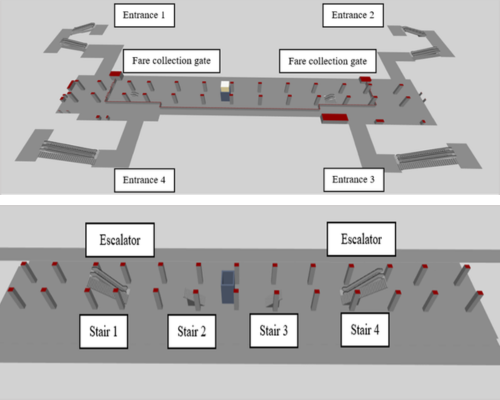
Rather than relying solely on default behavioral settings, the model was iteratively adjusted until key simulated performance measures closely matched observed passenger behavior.
This created a stronger foundation for evaluating both day-to-day operations and emergency evacuation scenarios.
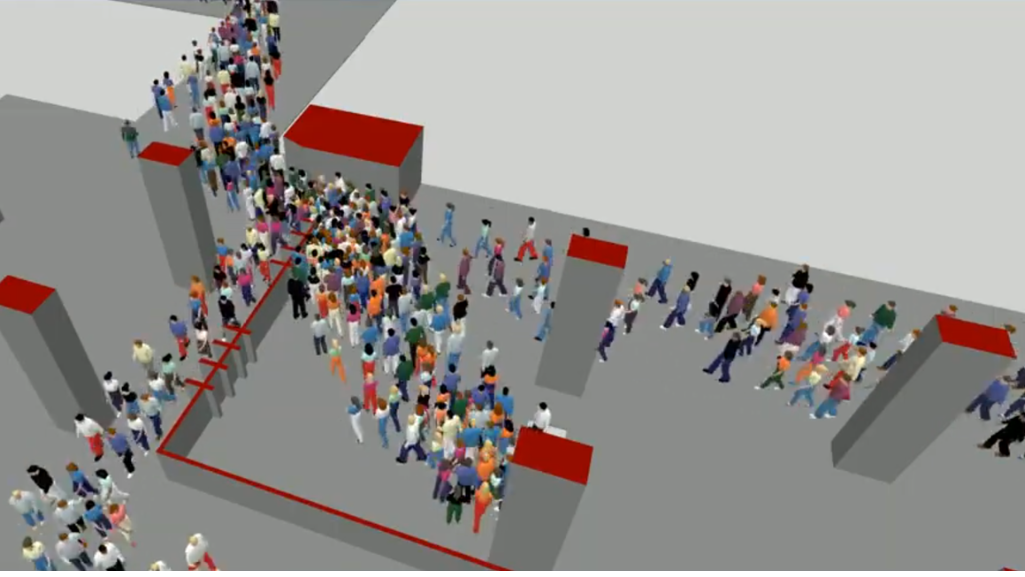
PTV Viswalk was particularly valuable during this process because it allowed me to analyze multiple operational characteristics within the same model. These included walking speeds, pedestrian interactions, queueing behavior, bottleneck performance, and route choices throughout the station.
Model Validation
A key question for simulation practitioners is whether calibrated pedestrian parameters remain reliable when applied outside the original study area.
To test this, the calibrated parameter set developed at MRT Huai Khwang Station was applied to MRT Sukhumvit Station, one of Bangkok’s busiest metro stations.
I compared the model outputs with observed passenger behavior. I also compared the results with default parameter settings and previously published parameter sets.
The validation showed that the locally calibrated model achieved the lowest average error, approximately 3.9%. It consistently matched observed pedestrian movement more closely than both default settings and alternative parameter sets.
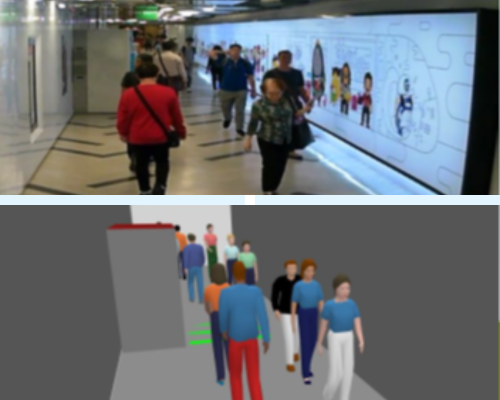
For transport consultants and traffic engineers, this result is significant. Before simulation outputs are used to support station upgrades, operational changes, or safety-related recommendations, model performance must be demonstrated under real operating conditions.
The validation provided confidence that the calibrated model could support subsequent evacuation and safety analyses with a higher degree of reliability than generic parameter assumptions.
Evaluating Evacuation Readiness
After validating the model, I used it to assess evacuation readiness at MRT Huai Khwang Station. This is one of the most valuable applications of pedestrian simulation: evaluating safety performance before implementing infrastructure or operational changes.
Real-world evacuation testing can be disruptive, costly, and difficult to repeat under different conditions. PTV Viswalk allowed me to use pedestrian flow simulation to evaluate these scenarios in a controlled environment while maintaining realistic passenger behavior.
I tested evacuation scenarios under both normal emergency operations and more restrictive conditions, where only limited fare gate capacity was available. Then, I measured evacuation times from the platform to safe areas under current passenger demand and projected future ridership levels.
These scenarios helped identify whether existing infrastructure could continue to meet evacuation requirements under both current and future demand conditions.
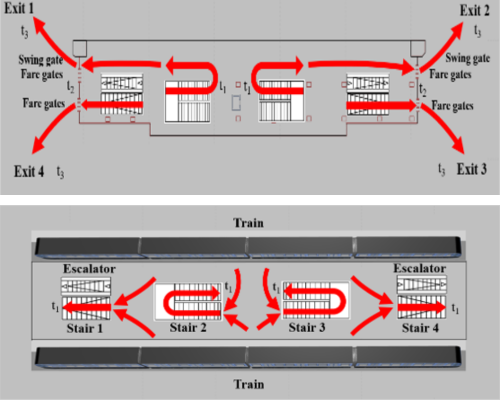
Evaluating future demand was particularly important because MRT ridership had been growing steadily. This raised questions about whether the station could continue to meet operational and safety requirements as passenger volumes increased.
Key Findings
The pedestrian flow simulation showed that MRT Huai Khwang Station met both national and international evacuation requirements across all tested scenarios, including projected future passenger volumes. This indicated that the existing station layout could continue to support safe evacuation as demand grows.
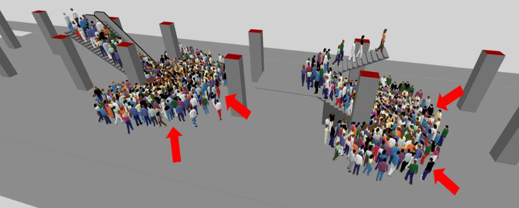
At the same time, the model highlighted potential future congestion around the fare gate area under more restrictive emergency conditions.
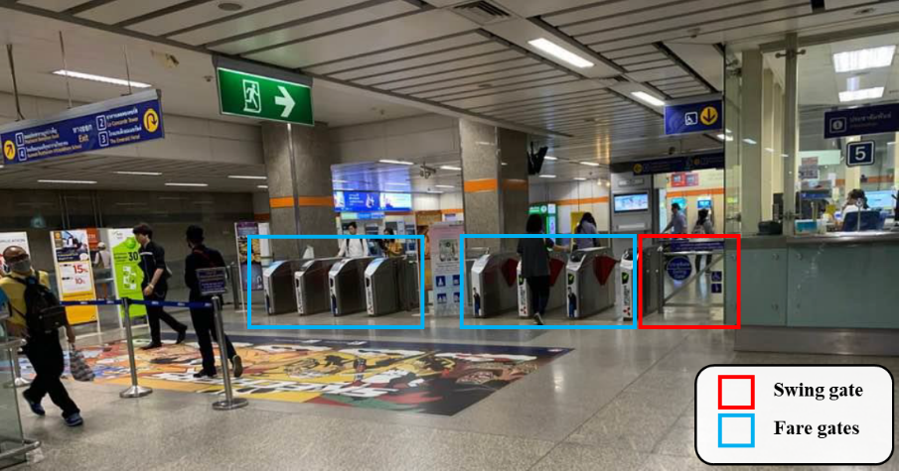
Although the station remained compliant, the analysis identified an opportunity to improve evacuation performance. Additional emergency exit capacity near the fare collection area could help reduce future bottlenecks and improve resilience as ridership grows.
Lessons for Planners
The most important lesson from this study is that confidence in simulation results must be earned through calibration and validation.
The Bangkok case study showed that calibrated pedestrian behavior improved model accuracy and provided a credible basis for evacuation analysis and future-capacity assessments.
Based on this experience, three practices are essential when using pedestrian simulation to support planning decisions:
- Collect representative field observations whenever possible.
- Calibrate key behavioral parameters rather than relying solely on default settings.
- Validate the model before using it to support operational, investment, or safety recommendations.
When applied rigorously, pedestrian flow simulation becomes a decision-support tool that helps planners test scenarios, assess risk, and identify improvement opportunities before changes are implemented. As transit networks continue to expand, this approach can support more informed decisions about station operations, future capacity, and evacuation readiness.

Plan Safer Stations with Pedestrian Simulation
Explore how PTV Viswalk helps analyze pedestrian movement, bottlenecks, capacity, and evacuation performance
Get a free Viswalk demo
Related Posts