Table of contents
Every great innovation has a story, and PTV Viswalk is no exception. Join us on a journey through the milestones that have shaped PTV Viswalk over the past 18 years and discover how it developed into the powerful simulation model it is today.
Welcome to the world: PTV Viswalk is born
On July 30th 2008 the first setup package of “Vissim with pedestrians” was uploaded to the setups server.
Time to have a look through the photo album. From its mother PTV Vissim PTV Viswalk did not only inherit a decent 3D look, but also it was able to cross a road from its first day on, strictly obeying red traffic lights
Already half a year later, it learned how to queue orderly. What it also did – and what children of that age should not do – was that it walked stairs all alone. It fell off more than once and learned how to avoid that with its first birthday.
Short time later it learned how to ride trains and busses. It even started to explore the world on Partial Routes before its second birthday.
Given that it exhibited all these abilities so early, it may come as a surprise that it struggled – at least when in groups – with rounding corners until after its second birthday. Only then it exhibited potential – Dynamic Potential to be precise – to also master this task.
PTV Viswalk turns three
At the age of three, when it began to get around independently of its mother PTV Vissim, was when it was baptized. Typical for that age is a fascination for escalators which it explored intensively at that time.
By the age of 6 PTV Viswalk started to question rules: it was spotted for the first time to walk at red.
With 7 years it got interested in more abstract concepts like User-Defined Attributes and Building Information Modelling, which gave it a great lot of freedom and autonomy.
PTV Viswalk turns eight
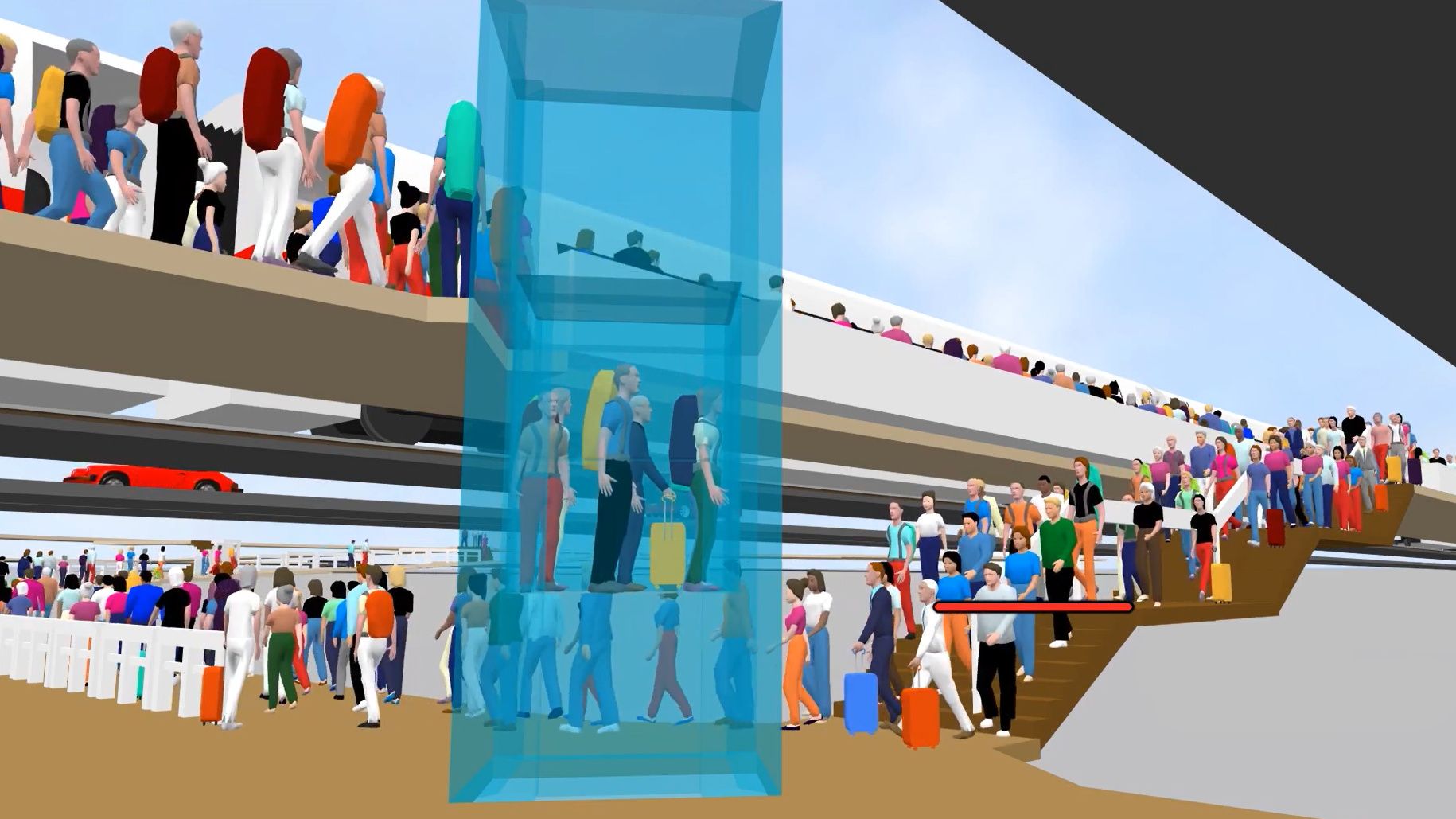
Can you remember the joy, when it rode an elevator for the first time when it was 8?
Increasingly, it faced the hardships of life: at 10 it had to learn how to navigate around cars blocking its way, how to escape from fires (at 11) and in 2020 it had to learn to keep a distance in queues and when waiting for a bus.
In the years following, from the outside you did not see a lot, but within a lot happened: it qot more aware of itself, of its pulse, pondered a lot about the nature of time. This resulted – an important part of growing up – in PTV Viswalk behaving reliable, predictable, reproducible.
PTV Viswalk turns 16
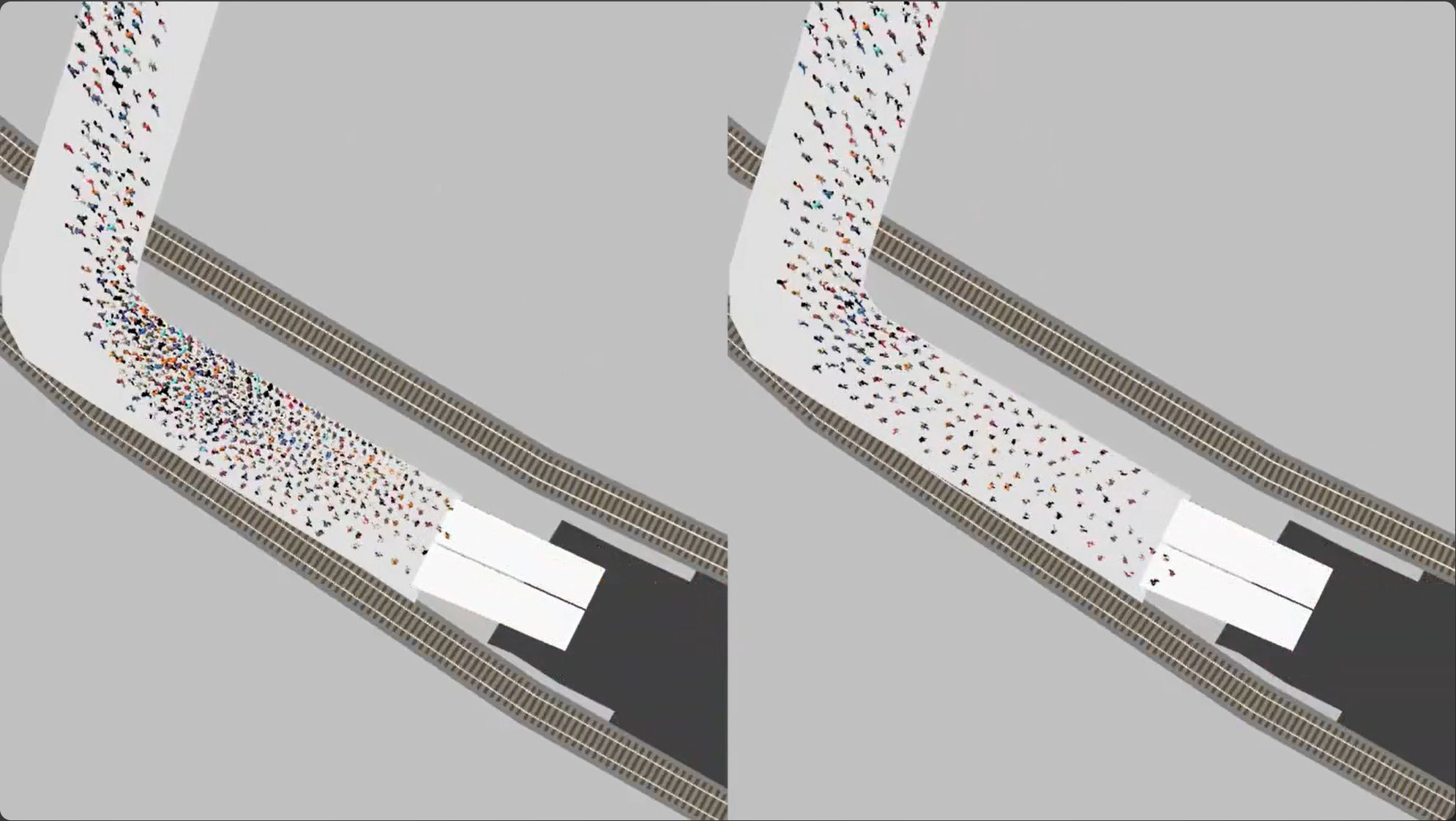
©PTV Group 2026 – PTV Viswalk Ingress/Egress
At the age of 16 it visibly developed Walking Attractiveness. So, might it become a model? Maybe. In fact, Walking Attractiveness has already become a model for a model of crowd dynamics that balances the force-based and the potential-based approach.
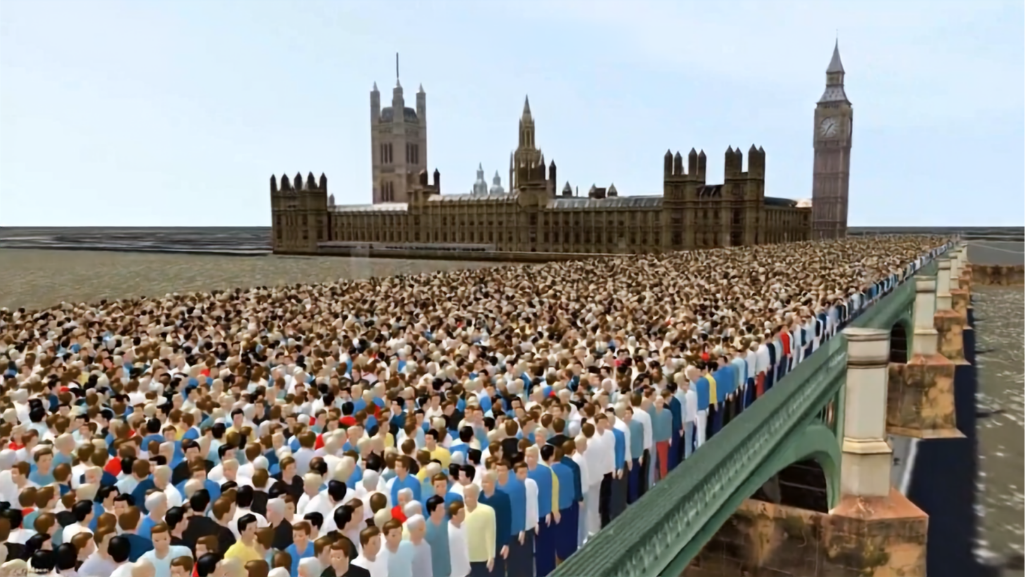
All along the way, it learned how to run faster and attended ever larger scenes and crowds.
Finally of legal age
So, PTV Viswalk officially is a grown-up now! The only thing left to ask is: What is next? Naturally, getting a drivers’ license to connect to cars as it has connected to public transport so early? Maybe. But why not learn how to jump on a bike and ride it – on the road or through a crowd of pedestrians? Or maybe learn how to walk with a group? Or better learn how to find reasonable routing alternatives on its own, to relieve the user from this task?

Crowd and Traffic Simulation for Major Events and Venues
Find out how PTV Viswalk help to manage complex traffic and crowd flows at major events.
Related Posts