Table of contents
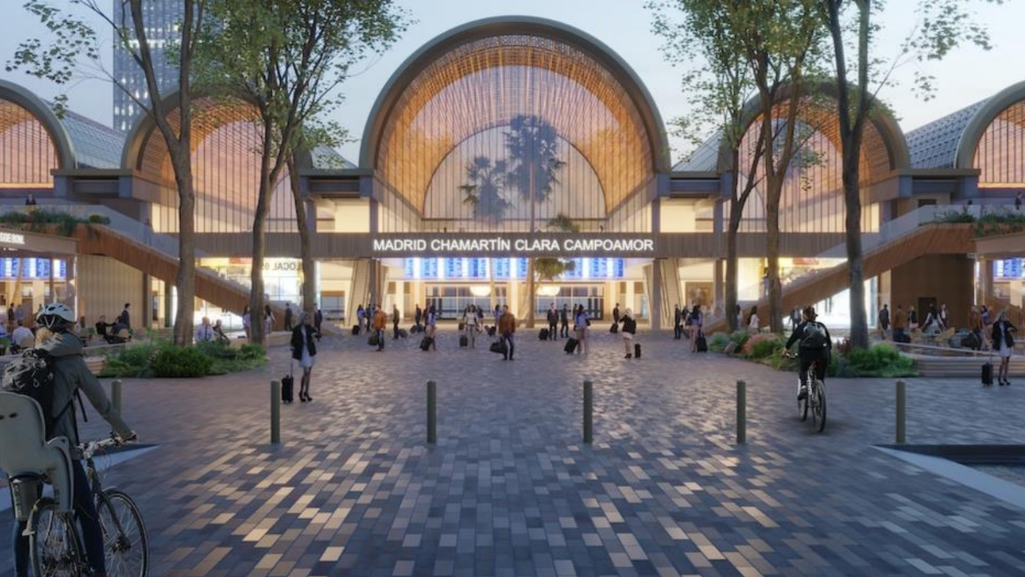
Madrid-Chamartín Clara Campoamor is Madrid’s second-largest railway station and a major multimodal interchange, connecting rail services with metro and bus networks. To support its phased transformation, we used multimodal station microsimulation to assess how the station would perform under evolving operating conditions and peak-demand scenarios.
The ongoing transformation is part of a long-term strategy to develop the facility into one of Europe’s largest sustainable transport hubs. As the future gateway to the Madrid Nuevo Norte district, the station will play a key role in connecting northern Madrid with this major urban development.
In 2025, Madrid-Chamartín handled 46.2 million passengers while remaining fully operational throughout ongoing construction works.
This combination of high passenger volumes and continuous redevelopment creates a significant planning challenge. Passenger routes change, temporary constraints emerge, and the greatest operational risks often occur during intermediate construction phases rather than in the final station layout.
In this article, we share how the DOYMO project team used PTV Vissim and PTV Viswalk to stress-test phased operating concepts at Madrid-Chamartín. The focus is practical: maintaining decision-ready models, identifying bottlenecks before they affect operations, and translating simulation results into design actions while changes are still feasible.
Context
The transformation of Madrid-Chamartín goes beyond a capacity expansion. The project includes an extension of the existing South Terminal, the creation of additional access points to the future North Terminal, a reorganization of passenger circulation, and stronger intermodal connections, all while the station remains operational.
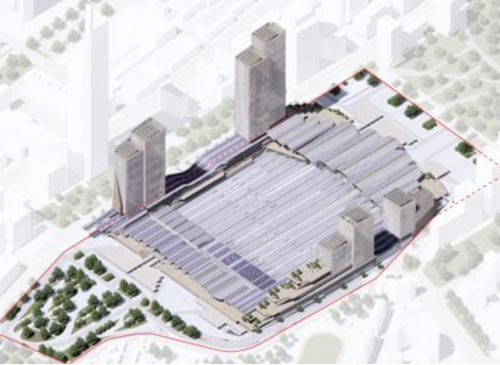
Phasing changes the “rules of the station” repeatedly. A corridor that performs well in the final layout may operate under constrained conditions for several years, while temporary access arrangements can become the dominant passenger experience during extended construction periods.
As a result, each phase must be evaluated not only as a step toward the final design, but as a functioning station.
Why simulate
Static checks provide only a snapshot of performance. In phased station projects, critical issues often emerge during short peak periods when passenger flows overlap and temporary layouts constrain circulation routes.
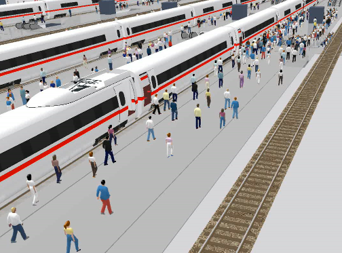
We used microsimulation to validate proposed solutions before implementation and maintain safe, robust operations throughout the transformation.
Objectives
We structured the work around five objectives that are common in complex station projects:
- Optimize station functionality and the passenger experience.
- Assess the capacity and Level of Service (LoS) of station entrances and internal circulation routes.
- Identify and quantify safety, congestion, and bottleneck risks in critical areas.
- Analyze interactions between pedestrian flows, public transport, and private vehicles, because hubs fail at interfaces, not in silos.
- Validate proposed design solutions before implementation.
Scope
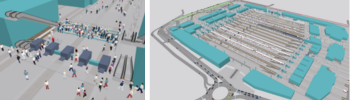
We used PTV Vissim and PTV Viswalk to build a microscopic multimodal model of both station operations and the surrounding access environment.
On the pedestrian side, we modelled flows through concourses, platforms, corridors, underpasses, stairs, lifts, and station access points. The model also included connections to taxi ranks, bus stops, parking facilities, the metro station, and a planned transport interchange. These links play a critical role in crowd formation, as small disruptions can quickly create local density hotspots.
On the traffic side, we represented private vehicle and public transport movements in the immediate station area, including parking access and drop-off operations. This is important because curbside congestion can affect pedestrian conditions, and vice versa.
To support rapid design iterations, the station-area model was simplified where appropriate. Higher levels of detail were applied to internal corridors, access zones, and the six-story public and ADIF parking facility, where flows converge and operational performance is most critical.
Scenarios
We tested scenario families designed to reflect the highest-risk operating conditions:
- Phased operating concepts. We simulated multiple operating configurations across construction phases, including alternative distributions of arrivals and departures between terminals. These configurations significantly influenced the location and intensity of passenger cross-flows.
- Peak stress moments. We simulated short-duration peak periods where multiple train movements overlap within minutes, creating concentrated passenger surges in corridors and concourses. In the maximum-capacity test, we simulated three high-speed arrivals and three departures within a 10-minute period, each carrying 840 passengers, to represent the most demanding operating conditions.
- Evacuation. We simulated platform evacuation across phases and operating configurations, as temporary constraints can reduce route choice and limit access to critical vertical connections.
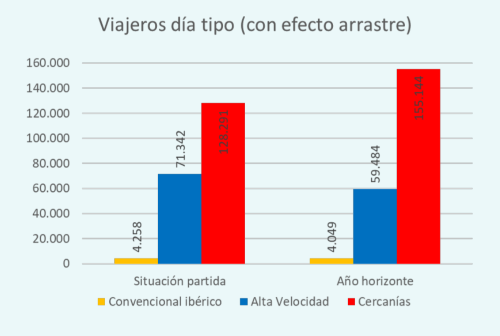
We also compared an early works phase with a longer-term horizon, because phasing risks often emerge from the differences between temporary and final operating conditions.
What we found
Two lessons are transferable to other major stations:
- Separating flows reduces risk at peak. Operational concepts that separated passenger streams more clearly performed more robustly under peak conditions. Variants with greater levels of cross-flow remained feasible but generated higher local densities and reduced resilience when demand peaks overlapped. For planners, the message is simple: flexibility in terminal use can be attractive, but it often comes with a cross-flow penalty.
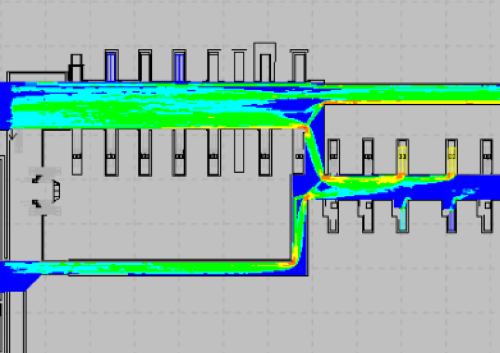
2) Phasing is where robustness is won or lost. A strong final design can still perform poorly during intermediate phases. When a station remains operational while terminals, corridors, and vertical circulation are upgraded, temporary arrangements can become the dominant passenger experience for years. These phases often have the tightest operational and safety margins.
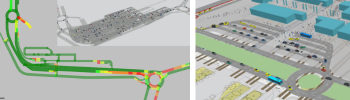
On the access side, we assessed whether station operations could create spillbacks or instability on the surrounding network and curbside areas. This is an essential check in any multimodal station project because external access failures can quickly translate into internal crowding.
From results to actions
Microsimulation creates value only when it leads to specific, implementable decisions.
Based on identified cross-flow pressure points, we proposed adjusting the entrance and exit locations of the high-speed concourse to reduce conflicts between arriving and departing passengers.
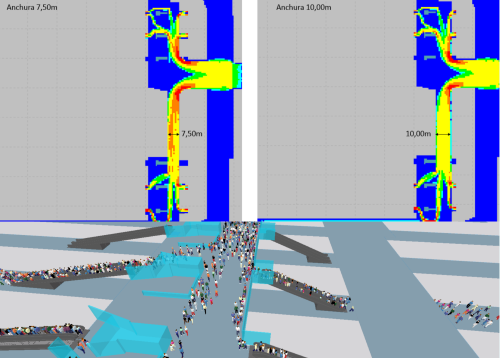
We also recommended increasing the width of the high-speed concourse in the North Terminal area to improve comfort and operational resilience during peak periods.
For early construction phases, we proposed a temporary footbridge to improve evacuation performance in the northern platform area. Temporary route availability can have a greater impact on evacuation outcomes than the final station layout.
Checklist you can use
Use this checklist when scoping a multimodal station microsimulation project or reviewing an existing model:
- Define stress moments first, including overlapping arrivals, short demand peaks, disruptions, and evacuation scenarios.
- Model key interfaces explicitly, including boarding and alighting, vertical circulation, crossings, and curbside operations.
- Combine network-wide coverage with detailed hotspot modelling to balance speed and accuracy.
- Test alternative operating concepts as separate scenarios, because terminal roles and phasing can influence outcomes as much as physical design.
- Translate simulation outputs into design actions early, while changes remain feasible and cost-effective.
Conclusion
For planners, keeping a station operational throughout construction is more than an operational constraint. It is often the defining design challenge.
Multimodal station microsimulation helped us evaluate station performance throughout the transformation process, identify potential bottlenecks, and prioritize targeted design improvements before implementation.
As a result, the project team was able to strengthen operational robustness and the passenger experience before finalizing the design.

Simulate complex stations and hubs
Use traffic simulation to test phasing, multimodal interactions, and scenarios before construction decisions become irreversible
Simulate complex stations and hubs
Use traffic simulation to test phasing, multimodal interactions, and scenarios
before construction decisions become irreversible
Related Posts