Table of contents
Concerts, sporting events, festivals and public celebrations: behind every major event lies an enormous amount of planning. Cities spend months, sometimes even years, preparing venues, coordinating security, organizing public transport and developing traffic management plans. Yet when the event finally arrives, headlines are often dominated by a different story.
Visitors miss kick-off because they cannot reach the stadium. Public transport becomes overcrowded. Parking facilities fill earlier than expected. Transportation networks already operating near capacity are pushed beyond their limits, leaving residents, commuters and commercial deliveries caught in hours of congestion. Suddenly, transportation, not the event itself, becomes the main topic of discussion.
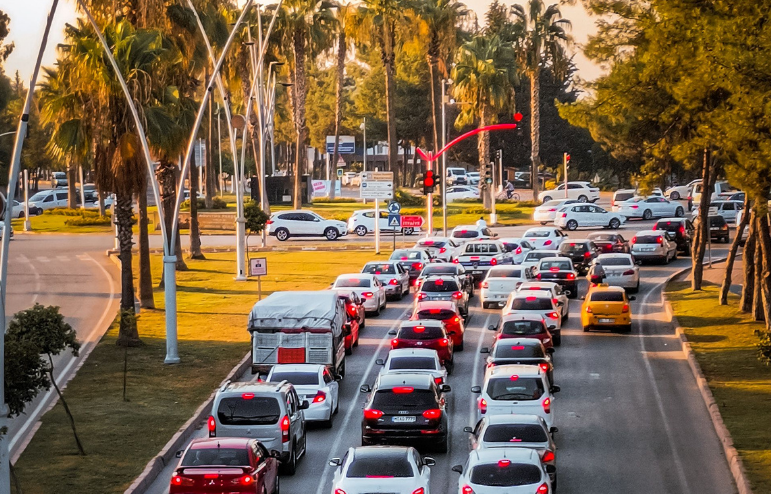
This pattern has played out repeatedly across North America in recent years. While every event is different, the mobility challenges behind them are remarkably similar.
A Familiar Pattern
Consider just a few recent examples.
At the 2024 Copa América Final in Miami, severe congestion and crowding around Hard Rock Stadium delayed thousands of spectators from entering the venue. The situation became so critical that kick-off itself had to be postponed while fans were still waiting outside.
When Rogers Stadium in Toronto opened in 2025, visitors reported extensive traffic congestion, confusing pedestrian routing, overcrowded transit stations and long delays leaving the venue. Even Coldplay acknowledged the difficult journey fans experienced.
At Formula 1 in Las Vegas, months of road closures and traffic restrictions affected not only race visitors but also residents, commuters and local businesses. The challenge was no longer simply getting spectators to the venue, it was keeping the entire city functioning.
International soccer matches at MetLife Stadium in New Jersey exposed overloaded rail services, insufficient shuttle capacity and thousands of late arrivals, prompting transportation agencies to rethink their planning approach ahead of the FIFA World Cup 2026.
Even Burning Man, where extreme weather triggered the initial crisis, demonstrated how quickly mobility itself can become the dominant operational challenge when a single access route fails.
Different cities. Different events. Different organizers. Yet the same questions emerged every time. Why did transportation become the biggest challenge?
Major Events Don’t Simply Create More Traffic
“Mayor event not only affect the venue itself. They place pressure on entire transport networks, public spaces and city centres”, explains Hilary Aylesworth, Chief Product Manager at PTV Group, part of Umovity. “They do not only generate higher traffic volumes, but they also fundamentally change how people move through a city.”

A study by the Technical University of Munich, for example, analyzed mobility during Taylor Swift’s 2023 concerts at Soldier Field in Chicago, attended by around 60,000 visitors. The researchers found that travel demand was far more complex than attendance figures alone would suggest. Around half of the analyzed visitors travelled by private car, while others relied on public transport or ride-hailing services, creating very different pressure points across the network.
As venue gates opened, average vehicle speeds on the main access road dropped by almost 50 percent. After the concert, when thousands of visitors left within a short period, average speeds fell by more than 75 percent compared with a typical Friday.
Unlike everyday commuting, event traffic arrives in concentrated waves. Tens of thousands of visitors head toward the same destination within a relatively short period, often using unfamiliar routes and different modes of transport.
Roads become congested. Ride-hailing demand surges. Parking facilities fill unevenly. Transit stations experience short but intense peaks. Once the event ends, the entire process repeats in reverse as thousands of people leave simultaneously.
At the same time, residents continue their daily routines, deliveries still need to be made, public transport must serve both visitors and commuters, and emergency services require unrestricted access.
“This extraordinary demand exposes weaknesses across the entire transportation system very quickly,” says Aylesworth. “When additional disruptions occur—roadworks, an accident on a key access route, a tram breakdown or severe weather—the result can quickly escalate into major congestion. That doesn’t just affect the visitor experience. It also frustrates residents, impacts businesses and puts additional pressure on transport operators.”
What cities can do is ensure they are prepared
No city can eliminate every disruption. Unexpected weather, incidents and operational challenges will always be part of hosting large public events.
Municipal authorities, transport operators, venue managers, engineering consultants, emergency services and event organisers all contribute to event planning from different perspectives. Decisions made in one area frequently influence outcomes elsewhere. Changes to parking capacity affect public transport demand. Pedestrian routing influences road operations. Temporary traffic measures may alter emergency access or local traffic conditions.
Developing an effective mobility strategy therefore requires understanding how these individual decisions interact across the wider transportation network.
“This is where Event Mobility Intelligence comes in,” concludes Aylesworth. “It provides a common analytical framework for understanding these interactions before the event takes place. By combining strategic planning, operational assessment and shared mobility insights, cities can evaluate alternative scenarios, identify operational constraints early and coordinate decisions across all stakeholders.”
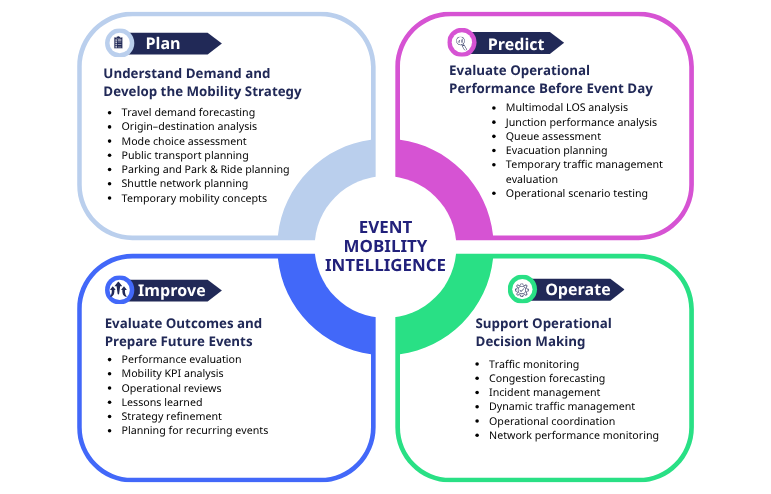
Successful event mobility dependson a clear understanding of how extraordinary demand will affect an entire city’s transportation network, and on the ability to plan for it with confidence. Event Mobility Intelligence provides a structured approach to planning for these conditions. It brings together travel demand planning, operational analysis and live traffic management into one continuous process, enabling organisations to develop coordinated mobility strategies before, during and after an event.
Rather than treating mobility planning as a series of separate activities, it helps stakeholders work from a shared understanding of how people and vehicles are expected to move across the transport network, supporting informed decisions throughout the event lifecycle.

A strong event mobility plan starts with the right questions
Download our free Major Event Mobility Planning Checklist
A strong event mobility plan starts with the right questions
Download our free Major Event Mobility Planning Checklist to:
- identify potential mobility pressure points;
- challenge demand and capacity assumptions;
- align planning across involved organisations;
- define the scenarios that require further analysis;
- prepare operational decisions and contingency measures.
Related Posts