

Inhaltsverzeichnis
- Many Mobility Measures – But Which Ones Really Work?
- The Fraunhofer IAO Project: Investigating Impact and Making It Visible
- User Behavior as the Starting Point
- Transportation Models Provide the Basis for Decision-Making
- From Analysis to Forecasting
- Better Decisions for Municipalities and Funding Agencies
- More Information about the Project
- Additional Information Traffic Models: The Key to Informed Decisions in Road Traffic
Many Mobility Measures – But Which Ones Really Work?
To achieve climate targets in the transportation sector, the German federal government supported innovative measures to strengthen local public transit as part of its 2030 Climate Action Program.
But before the federal government, states, and municipalities move into concrete implementation, one key question arises: Which measure will actually have the greatest impact? In many cases, there is no reliable, data-based assessment in advance of whether an investment in a new bus lane, an integrated ticketing system, or demand-responsive transit will lead to the desired modal shift and reduction in emissions. This is precisely where scientific evaluations and simulations of the impact come in, providing a solid foundation for decision-making
The Fraunhofer IAO Project: Investigating Impact and Making It Visible
To make these impacts visible, the Mobility Ecosystems team at the Fraunhofer Institute for Industrial Engineering IAO scientifically evaluated the funding program “Model Projects to Strengthen Public Transit.” Over a period of three years each, more than 300 innovative measures were implemented in 20 model regions across Germany. These ranged from improving service quality and operations to developing attractive fare models, digitally connecting information systems, and introducing new forms of on-demand transit.
The analysis of the impact of the measures was guided by the following questions:
- Do the measures increase the attractiveness of public transit?
- Does greater attractiveness lead to increased use of public transit?
- Does increased public transit use reduce private car travel?
- Does this modal shift contribute to lower emissions in public transit and in the transportation sector overall?
- To what extent can the emissions reduction be attributed to the measures?
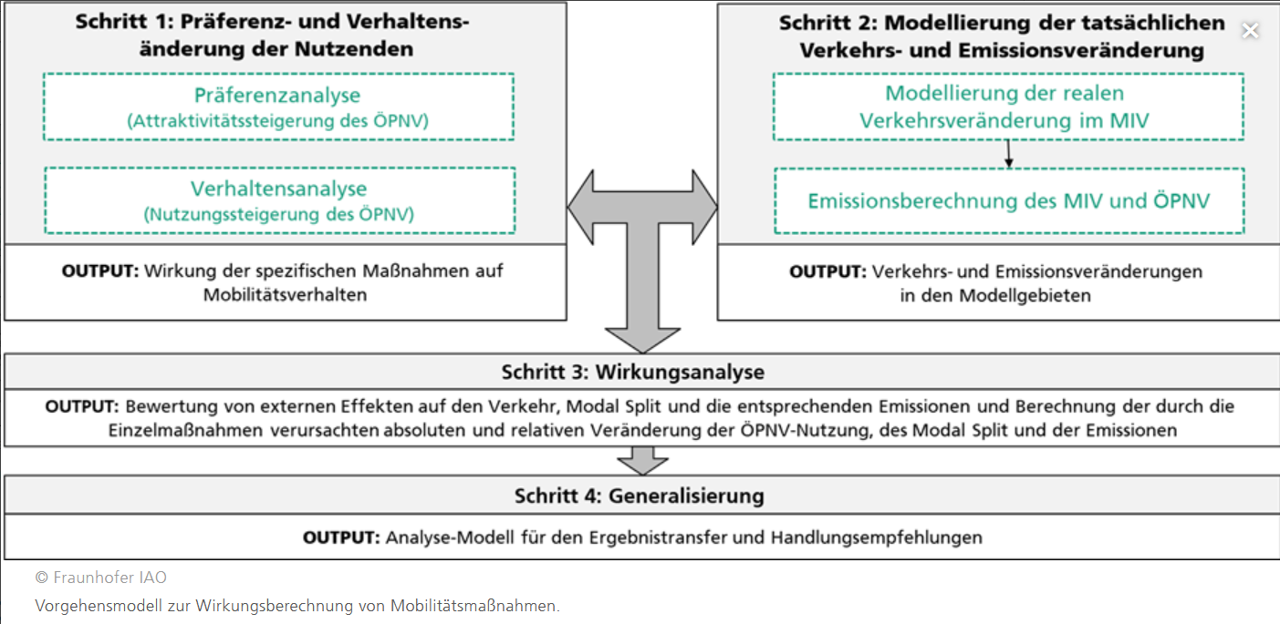
The simulation of the impact was carried out along with these questions. The aim was to quantify the increase in the attractiveness and use of public transit, calculate the resulting reduction in private car trips, and determine the associated emissions reductions.
The results show that the implemented measures were able to increase both the attractiveness and use of public transit in the regions. In addition, the evaluation demonstrates how the measures bring about tangible changes in transportation patterns, positively influence users’ mobility behavior, shift the modal split in favor of public transit, and sustainably reduce emissions in the transportation sector. A sound, model-based evaluation is therefore essential for precisely determining the impact of local measures.
User Behavior as the Starting Point
The evaluation is based on a user-centered methodology. It focuses on users and non-users, as well as on the influence of mobility measures on their mobility behavior. To analyze changes in preferences and behavior, online surveys were conducted in the model regions at the beginning of implementation, during the project period, and at the end of the project. Participants were asked about actual changes in their mobility behavior using the revealed-preference method.
In addition, hypothetical decision-making scenarios between car and public transit options with varying characteristics were used to capture intended choice behavior and user preferences using the stated-preference method. The utility functions derived from the results were validated against a utility function collected across Germany, as well as regional data on public transit use, such as ticket sales.
Transportation Models Provide the Basis for Decision-Making
The actual changes in transportation and emissions between the start and end of the funded projects were analyzed using the PTV Visum transportation simulation software and regional transportation models from PTV Validate. This made it possible to transparently and comprehensibly represent changes in travel demand, modal shift effects, and the resulting emissions impacts.
Using Monte Carlo simulations, the project participants integrated the survey results, including calibrated utility functions and behavioral change data, into PTV Visum. They then calculated the absolute and relative changes in private motorized transport, specifically the number of car trips, car emissions in CO₂ equivalents, and vehicle kilometers traveled by car.
From Analysis to Forecasting
The insights gained from the Fraunhofer IAO evaluation are more than a retrospective assessment. They provide a basis for realistically simulating future mobility measures at an early planning stage and forecasting their potential impacts.
For example, the Fraunhofer IAO study shows that on-demand transit and network expansions are particularly effective in rural areas, while digital services and multimodal offerings have the greatest impact in urban areas with already well-developed public transit networks. Transportation models can be used to represent these findings and reliably forecast the impacts of planned future mobility measures.
To transfer the findings to other municipalities and regions, the project participants generalized the results of the impact evaluation and analyzed their applicability to other areas.
Better Decisions for Municipalities and Funding Agencies
User-centered simulations of the impact can therefore create an objective basis for future investment decisions, the prioritization of public transit measures, and the targeted use of public funding.
Mobility measures often achieve their full impact only after several years, since changes in individual behavior take time to become embedded in users’ everyday routines. With modern simulations of the impact, however, the expected effects of public transit measures can be reliably forecast in advance. This gives implementation teams the confidence to select the most effective measures for their respective regions and to use funding in a targeted way to achieve the greatest possible benefit for mobility, climate protection, and society.
More Information about the Project
The Fraunhofer Institute for Industrial Engineering IAO scientifically evaluated the Federal Ministry of Transport’s funding program “Model Projects to Strengthen Public Transit.” From 2022 to 2026, the program funded a total of 20 model projects in two funding calls. The focus was on how various innovative mobility measures can increase the attractiveness and use of public transit, reduce private motorized transport, and lower car emissions.
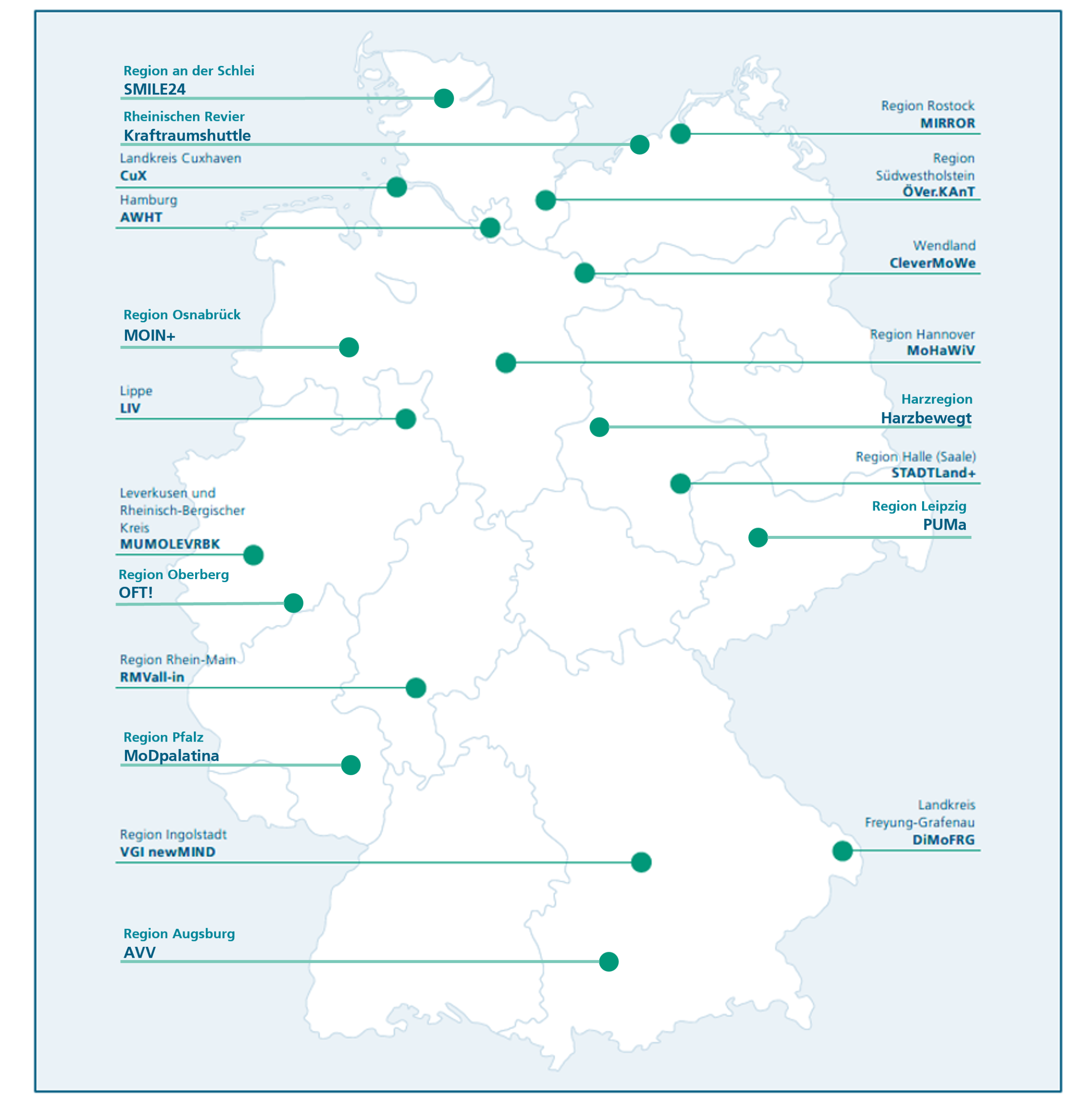
Read more information about the Fraunhofer IAO evaluation and the full project reports (in German) from the first funding call.
The Project in Numbers
- 20 funded model projects
- More than 300 measures analyzed to increase the attractiveness of public transit
- 40 interviews with model project managers
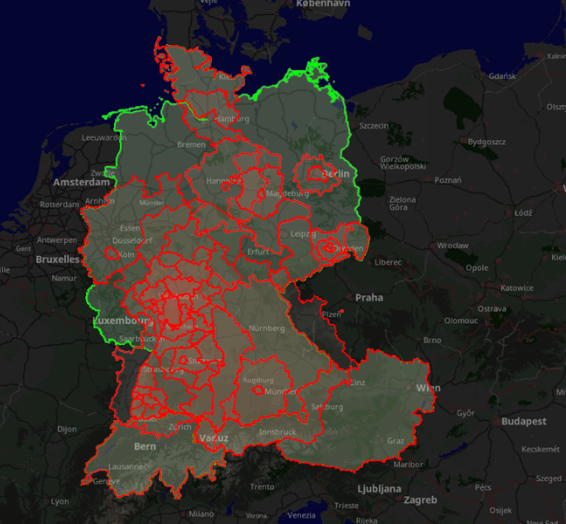
- 20 Visum transportation models for the model regions

Check out the free webinar on this topic!
Introduction in German; technical section in English
Additional Information
Traffic Models: The Key to Informed Decisions in Road Traffic
Traffic models serve as the starting point for sustainable transportation planning. Validate is one of the largest traffic models in the world.
Check out the free webinar on this topic!
Introduction in German; technical section in English
Related Posts