Table of contents
- What pedestrian crossing simulation reveals
- Sidwell junction: Compact layout, clear gains for pedestrians
- Alphington Junction: wider geometry, greater sensitivity to cycle time
- Five practical lessons for better pedestrian crossing planning
- A simple workflow for benchmarking crossing options
- Conclusion: Simulate first, signal later
You know the scene: the light turns green, yet vehicles remain frozen while a few late crossers finish making their way across. Minutes later, the pattern flips – vehicles surge, while pedestrians accumulate at the kerb waiting for the next cycle. These frictions aren’t random; they are the product of crossing design choices that can be analysed and improved through pedestrian‑crossing simulation.
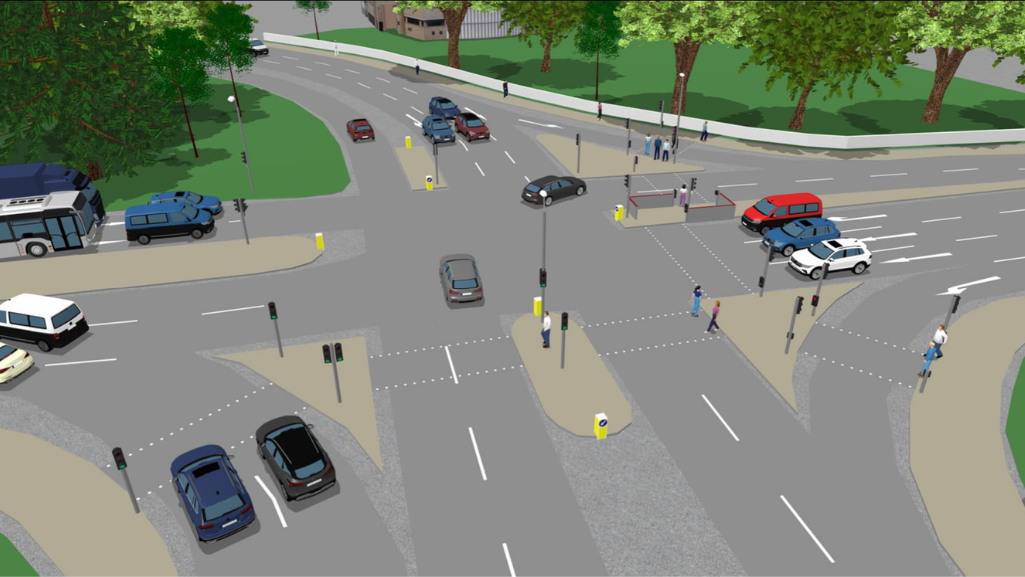
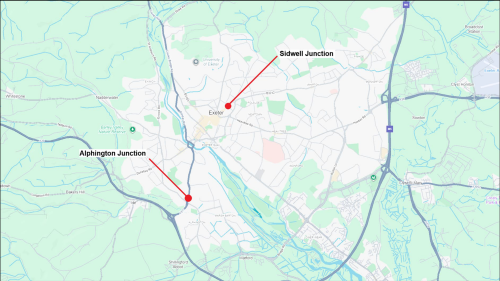
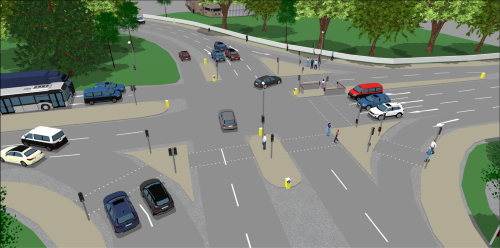
Using PTV Vissim, I benchmarked seven international pedestrian‑crossing designs – amber‑man, countdown, diagonal scrambles, and multiple left‑turn‑on‑red variants – across two real junctions in Exeter, UK.
This simulation‑based approach exposed performance patterns invisible in traditional signal‑timing spreadsheets and challenged assumptions about which designs deliver the best balance of safety, efficiency, and inclusivity.
At large junctions, for instance, allowing cautious left‑turn‑on‑red movements reduced average vehicle delay by 6 seconds; at compact urban junctions, countdown and amber‑man signals significantly improved pedestrian flow with negligible impact on drivers.
What pedestrian crossing simulation reveals
Pedestrian‑crossing planning is often grounded in intergreens (the time periods between the end of one signal phase and the beginning of the next), stagger distances, and compliance assumptions. But actual performance depends on interactions between modes – walking speeds, turning flows, speed distributions, and behaviour at the curb.
Using ten‑seed Vissim simulations for each scenario helped me compare queue lengths, journey times, and network performance with statistical reliability. Microsimulation highlighted trade‑offs that planners frequently overlook.
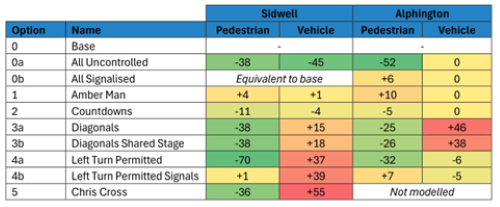
For example, diagonal scrambles cut pedestrian journey times by 80-102 seconds but increased vehicle travel time by 15–20 seconds due to extended pedestrian‑only stages. Over the course of a peak hour, these shifts can dramatically alter junction efficiency and user experience.
Sidwell junction: Compact layout, clear gains for pedestrians
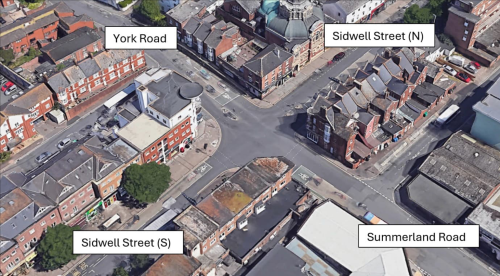
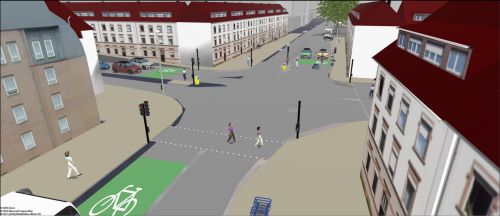
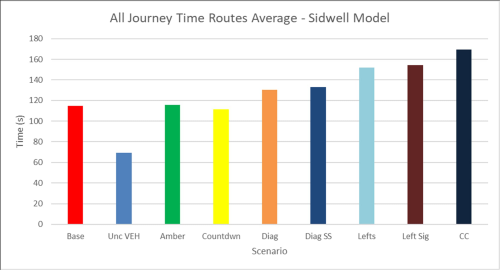
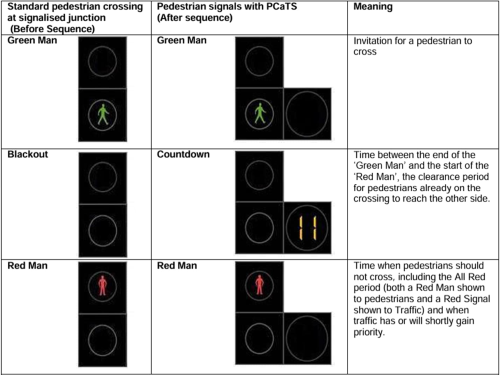
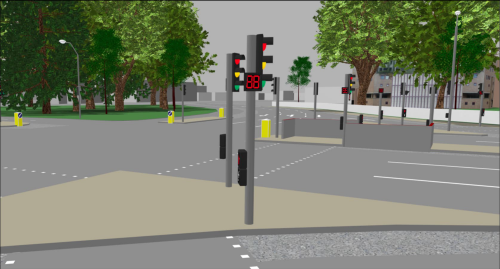
The Sidwell Street junction is a tight, pedestrian‑heavy junction in Exeter, with a dedicated pedestrian‑only stage. Here, my countdown crossings reduced pedestrian journey times by an average of 11 seconds thanks to clearer signal expectancy and slightly faster walking speeds.
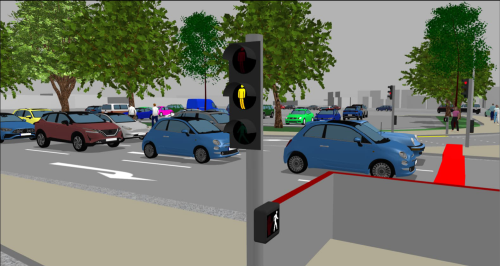
Amber‑man signals improved accessibility for slower users but added around 4 seconds of delay because slower pedestrians refrain from starting during the amber phase.
Diagonal scrambles delivered dramatic travel‑time reductions on diagonal routes – up to 80 seconds – but increased vehicle delays through longer all‑red periods. Meanwhile, left‑turn‑on‑red variants improved pedestrian movement (saving up to 70 seconds) but raised vehicle delay because they forced straight/right movements into fewer lanes.
For smaller urban junctions prioritising footfall and inclusivity, countdown and amber‑man provide the strongest overall return.
Alphington Junction: wider geometry, greater sensitivity to cycle time
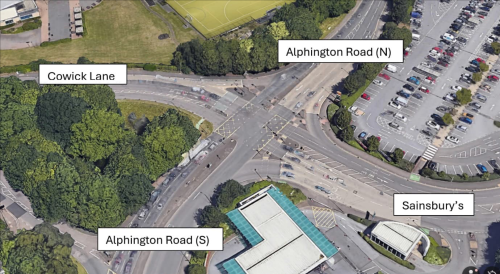
The Alphington junction’s broader geometry and higher traffic volumes made it more vulnerable to increased cycle lengths. Diagonal scrambles extended total cycle time enough to push the southbound approach over capacity, resulting in more than 3.5 minutes of additional delay for some vehicle movements.
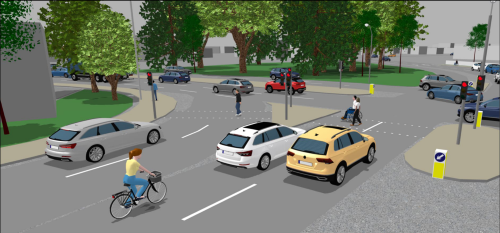
In contrast, amber‑man and countdown signals both delivered consistent, modest improvements for pedestrian and vehicle users. The strongest performer at this junction was the cautious left‑turn‑on‑red configuration. With existing filter lanes already separating left turns from through movements, this option produced an average 6‑second travel‑time improvement across the network and 25-30 seconds on left‑turn movements – all while maintaining pedestrian priority.
For large multi‑lane signalised junctions, left‑turn‑on‑red emerges as a highly effective, low‑impact optimisation.
Five practical lessons for better pedestrian crossing planning
1. Align crossing type with junction context: Countdown and amber‑man excel in dense pedestrian contexts, while left‑turn‑on‑red works best at wide, filter‑lane junctions.
2. Use simulation before committing to changes: Diagonal scrambles improve pedestrian routing dramatically but must be cycle‑time managed to avoid capacity issues.
3. Model behavioural change explicitly: Countdown crossings increase crossing speeds and reduce hesitation – small behavioural shifts that matter greatly for timing.
4. Consider lane allocations carefully: Allowing left‑turn‑on‑red can require shifting straight/right traffic into fewer lanes, potentially increasing delay in tight layouts.
5. Measure inclusivity, not only efficiency: Amber‑man rated highest in inclusivity, safety, and comfort; uncontrolled or shared‑stage diagonals rated lowest.
A simple workflow for benchmarking crossing options
- Map the junction, user flows, and crossing structures.
- Build and calibrate a Vissim base model that includes realistic pedestrian classes.
- Develop modular scenarios for designs such as countdown, amber‑man, scrambles, and left‑turn‑on‑red.
- Analyse queue lengths, delays, journey times, and network KPIs.
- Add qualitative evaluation—safety, inclusivity, user comfort, and installation cost.
Conclusion: Simulate first, signal later
Pedestrian‑crossing simulation reveals that crossing design choices shape how people move, wait, interact, and feel at junctions. Countdown and amber‑man signals improve inclusivity and reliability at compact sites, while left‑turn‑on‑red delivers meaningful vehicle benefits at large, multi‑lane junctions. Diagonal scrambles offer transformative benefits for pedestrians but require thoughtful cycle‑time management.
Using simulation before physical implementation ensures performance is measured, not assumed.

Improve safety with data‑driven analysis
Explore how simulation
helps reduce risks
and optimises crossings
Improve safety with data‑driven analysis
Explore how simulation helps reduce risks and optimise crossings
Related Posts