
Table of contents
At the end of October 2024, severe flooding struck the southern part of the Metropolitan Area of Valencia, home to nearly two million people. Heavy rainfall at the rivers’ headwaters caused widespread devastation, and the transport system was among the hardest hit. In a matter of hours, large parts of the network became unusable.
As the team at IDOM, we were faced with an urgent challenge: ensuring a minimum level of mobility for the metropolitan area while key transport infrastructures—especially commuter rail and metro services—remained out of operation. Speed, accuracy, and coordination were critical. To meet this challenge, we relied on PTV Software to rapidly analyze the situation, test scenarios, and support the design of an emergency mobility plan that could be implemented almost immediately.
Understanding the Initial Situation
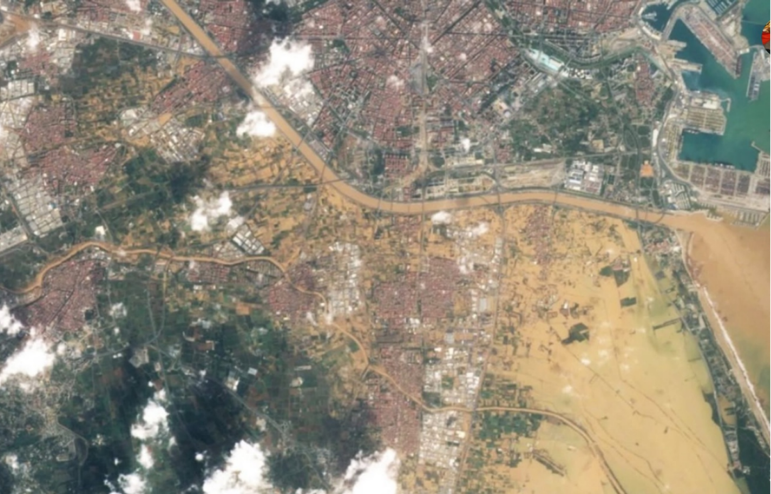
The impact of the floods on transport infrastructure was severe. In the southern part of Valencia, commuter rail (“Cercanías”) and metro tracks were completely devastated, and the metro system’s control centre suffered major damage. At the same time, road infrastructure experienced significant disruptions, including the Mediterranean Corridor bypass, the southern city entrance via the V-31, the A-3 motorway, and even parts of the high-speed rail network.
Beyond infrastructure damage, the floods had a dramatic impact on mobility resources themselves. Between 80,000 and 100,000 vehicles were destroyed, representing around half of the vehicle fleet in the affected zones, which are home to almost 400,000 residents. Half of the commuters who relied on public transport suddenly had no alternative, while half of the private vehicle fleet was no longer available.
Under these circumstances, it was clear that an emergency mobility plan was not optional—it was essential. The plan had to be designed and implemented immediately to maintain access to work, education, healthcare, and essential services until normal transport operations could be restored.
Identifying Critical Points
Given the urgency, we made intensive use of planning and modelling tools to develop a reliable emergency solution in a very short timeframe. Our primary objective was to deploy bus services across the metropolitan area to replace the non-operational metro and commuter rail lines. These services needed to minimize travel times and maximize frequency, while also acknowledging the inherent capacity limitations of buses compared to rail systems.
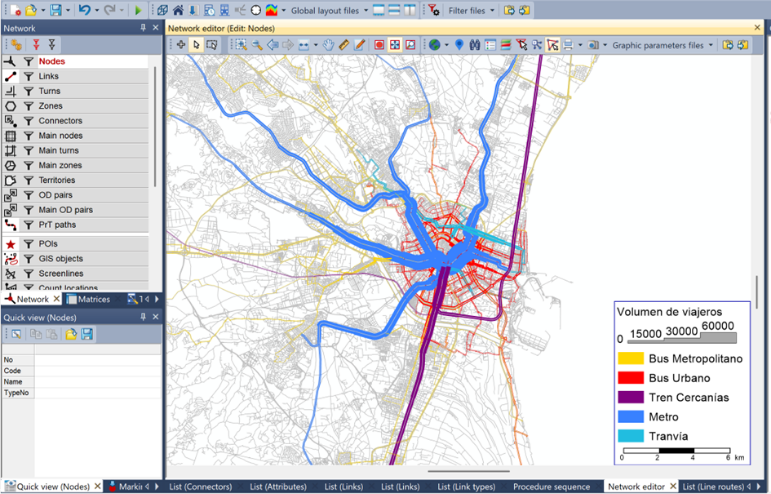
To achieve this, we relied on PTV Visum and PTV Lines which allowed us to quickly simulate multiple scenarios and identify critical bottlenecks.
The existing PTV Visum model of the Valencia Metropolitan Area is built with detailed mobile phone data. Even though the emergency affected nearly all major origin–destination relations, the four-step model allowed us to capture essential passenger demand patterns. It also provided key service-level indicators such as accessibility, journey times, transport supply, and activity patterns for a typical working day during peak hours.
This enabled us to formulate informed hypotheses about how mobility would change during the emergency period: shifts in demand, modal split variations, private vehicle usage, and the number of captive commuters with no alternative modes available.
Designing and Refining Emergency Bus Operations
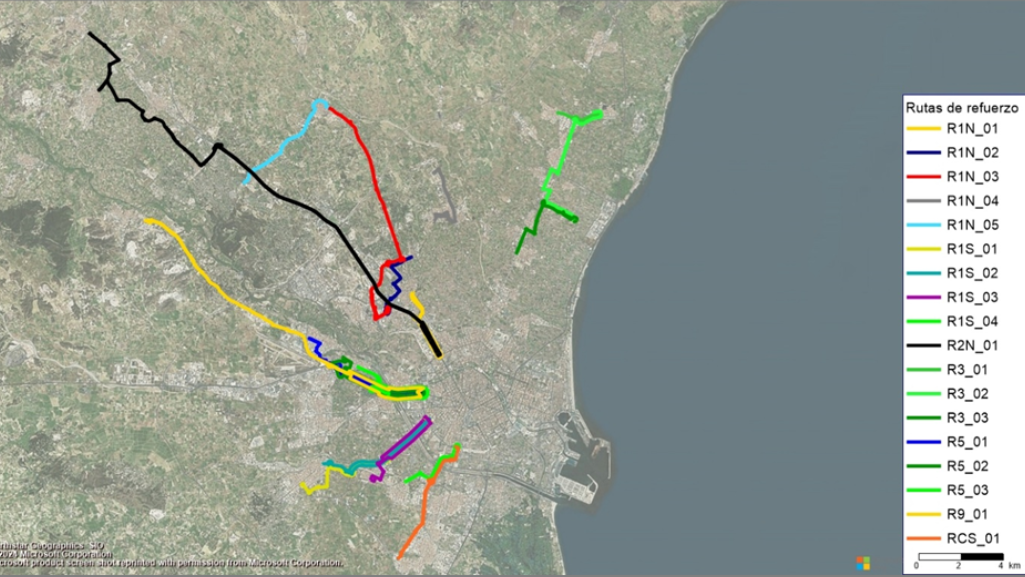
In a second step, we used PTV Lines to further refine the operational details of the emergency bus network. Thanks to its user-friendly interface, we were able to accurately design routes, analyze vehicle capacities, adjust stop locations, and evaluate timetables in detail. The tool also played a key role in ensuring coordination between different bus operators, supporting smooth intramodality during a highly complex operational phase.
A Rapidly Deployed and Adaptive Emergency Mobility Plan
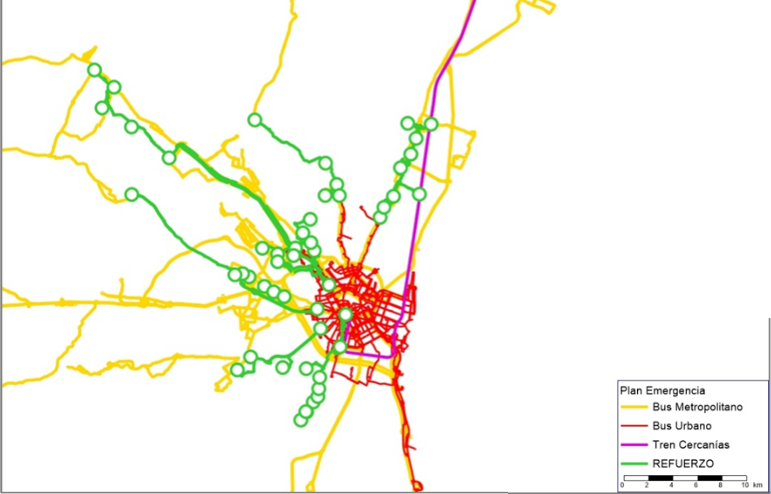
The result was a fully operational emergency mobility plan, designed and implemented in record time. The core strategy was to introduce bus services aligned with the non-operational metro lines, ensuring direct connections to the city of Valencia. These services enabled seamless transfers to the municipal bus network (EMT), which simultaneously reinforced its own operations within the city.
The plan successfully provided regular services with sufficient capacity to substitute damaged rail routes, closely matching expected demand and available resources. Most importantly, it ensured that metropolitan mobility could continue while major infrastructure was being repaired.
As recovery progressed, the emergency mobility plan evolved in phases, adapting to the gradual reintroduction of metro and commuter rail services. Demand hypotheses, service frequencies, and route configurations were continuously updated to reflect the changing situation.

PTV Lines – your solution for smart public transport planning
PTV Lines is built specifically for public transport planners – combining powerful functionality with ease of use.
Resilient Infrastructure That Endures Disruption
Transport systems are under pressure – from extreme weather, aging infrastructure, and chronic underinvestment. Discover how transport systems can adapt faster and recover smarter, through data-driven modeling, scenario testing, and proactive design
Related Posts