Table of contents
Whether you work on airports, rail hubs, hospitals, stadiums, downtown curbs, or university campuses, you’ve likely dealt with the same challenge: operations seem manageable from the driver’s seat, but the moment you try to model them, your “good data” starts failing you. That disconnect is exactly why airport curbside simulation matters – not only for airports, but for any high‑friction environment where behavior, not volume, determines performance.
In these systems, late and aggressive lane changes, bias towards more attractive locations at the curb, and the knock‑on effects of a single stalled vehicle can reshape demand in ways that spreadsheets will never reveal. Spreadsheets also assume every vehicle can make it to the curb to unload, but what happens when those vehicles are actually stuck in congestion a mile upstream of the curb?
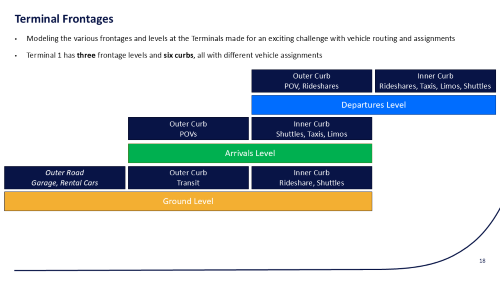
Airports simply make this reality impossible to ignore. At Toronto Pearson, stacked frontages, varied vehicle types, and challenging behaviors showed how quickly volume‑only assumptions distort outcomes. The complexity wasn’t just scale – it was behavior.
That’s why we built a PTV Vissim model focused on airport curbside simulation: not to study Pearson alone, but to demonstrate a universal point. If you plan, design, or simulate complex arrival and pickup zones of any kind, the insights from this work apply directly to your projects. [This article is based on the PTV webinar: Preparing Toronto Pearson Airport for the Future with Vissim]
Why Airport Curbside Simulation
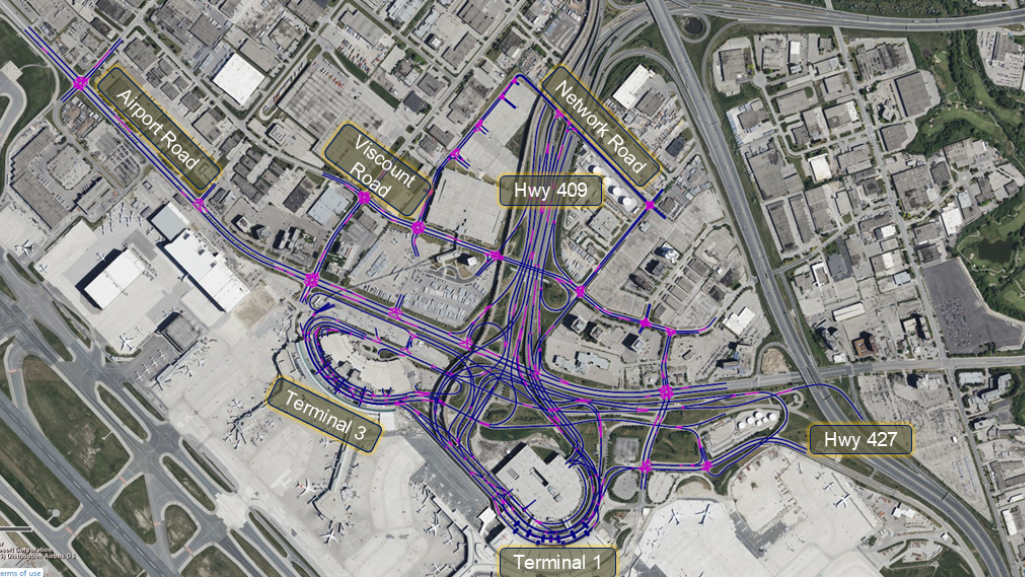
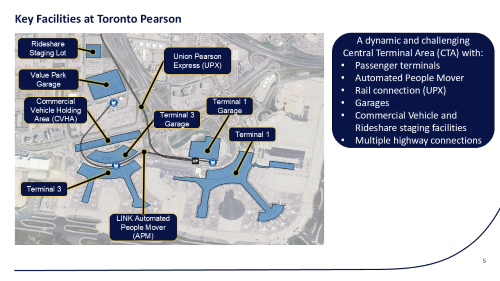
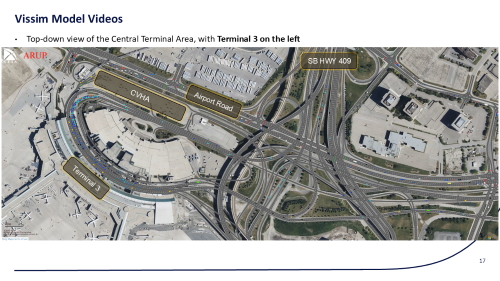
Pearson’s landside system includes two terminals, multi‑level frontages, garages, remote parking, a people‑mover, commercial‑vehicle staging, and local roadways feeding into the central terminal area.
Modeling just one link – only the curb, the internal roads, or the highway connectors – won’t reveal how congestion propagates between them.
The Greater Toronto Airports Authority (GTAA) asked our team at Arup for a holistic understanding of when and why facilities become overburdened, and what behavior drives those thresholds.
Passengers → Vehicles → Behavior
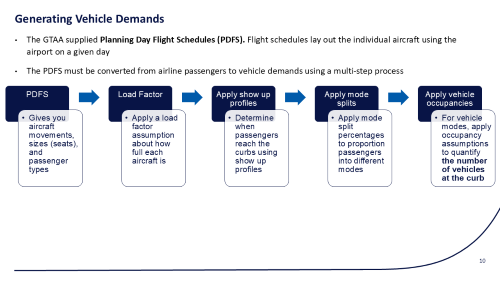
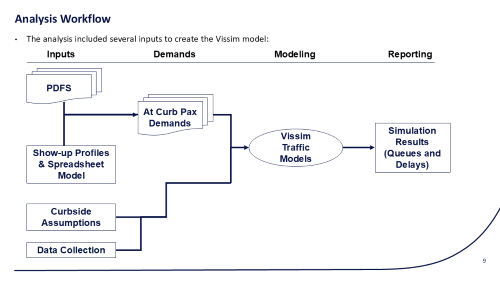
Airports can’t rely solely on Automatic Traffic Recorder (ATR) counts. Our workflow began with a planning‑day flight schedule; added aircraft load factors; applied show-up profiles to capture when passengers arrive or reach the curb; applied mode splits; and then used vehicle occupancies to convert at-curb passengers into vehicle demand.
This five‑step chain is essential: If you skip show-up profiles or ignore domestic vs. international patterns, your model can misrepresent peaks and congestion.
Where Defaults Fail
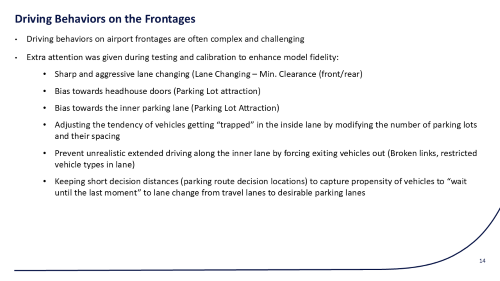
Airports do not behave like standard arterials or CBD curbs. If you rely on defaults, your simulation will be clean, attractive – and misleading:
Aggressive last‑second maneuvers require tight clearance lengths and short decision distances.
Door and inner‑lane bias must be encoded; travelers minimize walking and drivers cluster near entrances.
Inner‑lane trapping demands calibrated lane‑changing behavior or even restricted downstream movements.
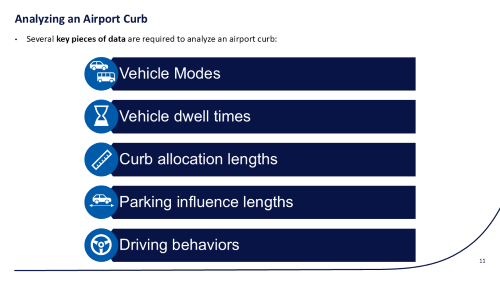
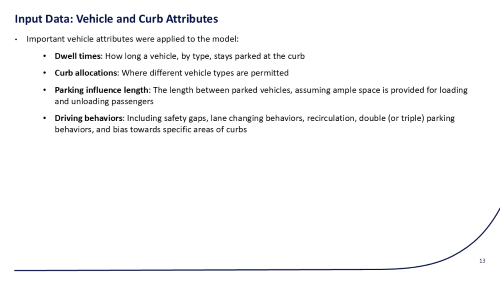
Parking influence lengths reduce effective curb capacity significantly; model the friction of luggage, open doors, and pedestrian movement between vehicles.
Taxi/Limo Bottlenecks
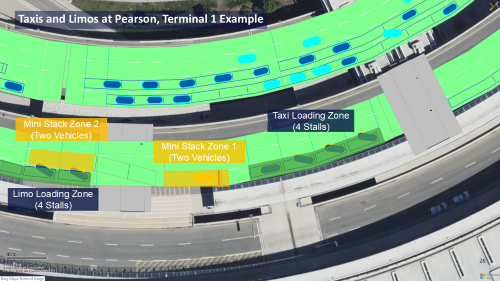
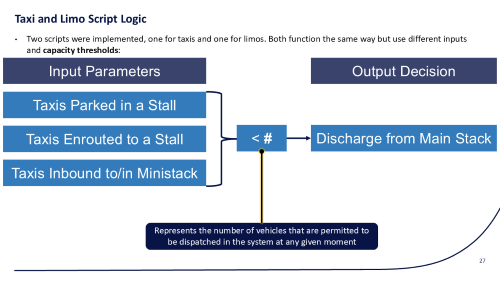
Taxis and limos aren’t demand‑driven; they’re supply‑controlled. At Pearson, they enter from a main stack, feed a mini‑stack, then advance into active loading stalls.
We implemented threshold‑based dispatch logic in VBA. Vehicles entered only when stalls were available. This prevented overstressing the curb and revealed an important insight: unmet demand at the stack didn’t mean a fleet shortage – just that the loading rate at the curb was the actual bottleneck.
Multiple Peaks, Not One
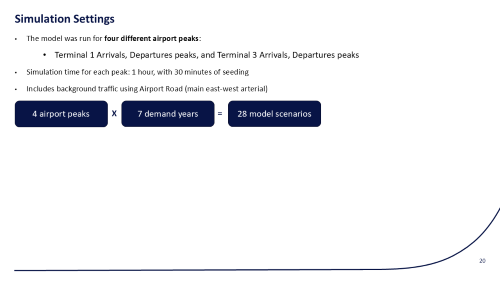
Airports don’t have a single peak. Pearson has four: arrivals and departures for both terminals. We simulated each peak plus shoulder overlaps – because combined operations often exceed any single peak. With 20+ scenarios, strict scenario management ensured comparability, traceability, and defensible recommendations.
Lessons for Planners
Defaults deceive at airports: Airport frontages will break generic behavior assumptions. Calibrate lane‑change aggressiveness, decision horizons, and inner‑lane escape behavior – your curbside throughput depends on it.
Demand building beats pretty animation: Spreadsheets can’t replicate the timing of real passenger behavior. Use flight schedules, show profiles, mode splits, and occupancy or your model will be “right” for the wrong reasons.
Biases are features, not bugs: Travelers prefer specific doors and drivers prefer inner lanes. Encode these biases explicitly.
Scenario discipline is strategy: Airports operate across overlapping peaks. Use structured scenario management to maintain consistent comparisons and avoid conclusion drift.
Why PTV Vissim
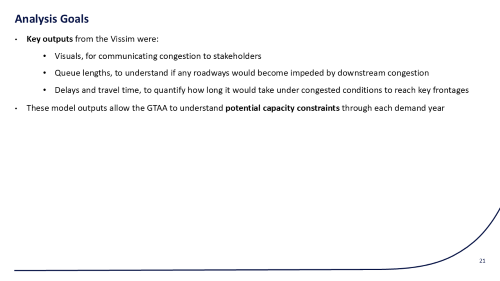
Vissim’s true advantage in airport environments isn’t microsimulation; it’s the ability to model real, sometimes chaotic, driver behavior. It let us:
- translate passenger activity into realistic vehicle arrivals,
- encode lane‑choice bias and last‑second maneuvers,
- implement taxi/limo dispatch controls that match operations, and
- reveal bottlenecks hidden by volume‑driven models.
For any complex pickup or drop‑off zone, these capabilities make the difference between a model that entertains and a model that informs.
Practitioner Notes
Behavior to Prioritize
- Decision distances: Use shorter distances near curbs; drivers make late decisions.
- Lane‑change clearance: Airports require more aggressive lane changes; reduce clearances.
- Inner‑lane escape: Vehicles loading in inner lanes shouldn’t merge out effortlessly; add behavioral resistance or restricted downstream options.
- Parking influence length: Encode friction from luggage, open doors, and between‑vehicle movement.
Frontage Decisions
For arrivals, encode door preference and inner‑lane bias explicitly.
For departures, respect domestic/international curb allocations; mis‑routing affects recirculation.
Parking & Dwell
- Use mode‑specific dwell times (POVs vs commercial).
- Allow for double or triple‑parking where observed but balance with attraction settings.
Taxi/Limo Dispatch
- Use threshold‑based releases from main stack → mini‑stack → stalls.
- Count routed vehicles and stalls explicitly to avoid unrealistic over‑acceptance.
Scenario Management
- Model the four peaks and shoulder overlaps.
- Keep runs organized for comparability.
Conclusion
Airport curbside simulation in PTV Vissim turns complex frontages into decisions you can defend – at Pearson and at any busy curb.

Traffic Simulation
in Action
Explore how traffic simulation helps you test curb designs, lane choices, and dispatch logic before you build
Traffic Simulation in Action
Explore how traffic simulation helps you test curb designs, lane choices,
and dispatch logic before you build
Related Posts